

Belgian deep tech startup Runeasi has secured €1 million in fresh funding to accelerate the global rollout of its AI-driven running and movement analysis platform. The round, led by Dutch venture firm Smarter Ventures with participation from existing investors Freshmen Fund and Gemma Frisius Fund, alongside Silicon Valley angel investor Sean Gourley, positions the KU Leuven spin-off for aggressive expansion into the United States market.
The investment comes at a pivotal moment for the sports physiotherapy sector. As healthcare systems worldwide grapple with rising musculoskeletal injury rates and the growing popularity of recreational running, practitioners are increasingly seeking tools that bridge the gap between laboratory-grade biomechanics and real-world clinical practice. Runeasi AI believes it has found that sweet spot.
What is Runeasi? The KU Leuven Spin-Off Bringing Lab-Grade Biomechanics to Mainstream Healthcare
Founded by Kurt Schütte and Tim Op De Béeck, Runeasi emerged from over a decade of collaborative research between KU Leuven’s Human Movement Biomechanics and Artificial Intelligence Research Groups. Unlike many wearable startups that prioritise consumer convenience over clinical rigour, Runeasi built its foundation on peer-reviewed science. All founders hold PhDs in sports biomechanics and sports data science, and the company’s technology has been validated through extensive academic research.
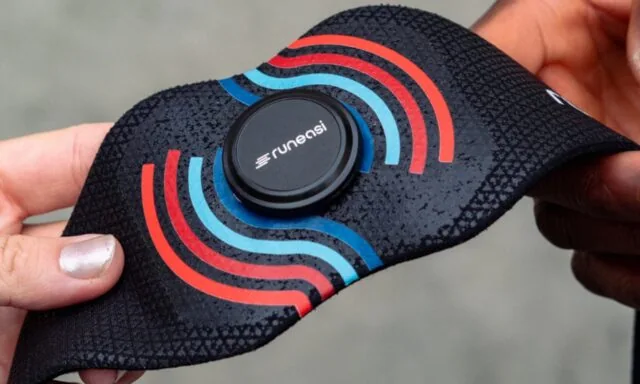
The system centres on a deceptively simple premise: a single Inertial Measurement Unit (IMU) sensor, worn on a specialised anti-slip belt at the sacrum (lower back), captures three-dimensional movement data that previously required expensive laboratory equipment. Within five minutes, practitioners receive a comprehensive Running Quality Score ranging from 0 to 100, alongside detailed breakdowns of impact loading, dynamic stability, and left-right symmetry.
This sacral positioning is deliberate. By measuring accelerations at the body’s centre of mass, Runeasi captures the cumulative effect of ground reaction forces travelling up through the kinetic chain, from foot to spine. Traditional gait analysis often relies on multiple sensors or camera-based motion capture systems that demand controlled laboratory environments. Runeasi’s approach works equally well on treadmills, outdoor tracks, or clinical hallways.
The platform translates complex biomechanical data into what the company calls “weakest links” visualisations. Rather than overwhelming physiotherapists with raw sensor readings, the system identifies specific areas of concern, generates automated PDF reports with colour-coded benchmarks, and provides personalised training recommendations. Real-time biofeedback capabilities allow practitioners to cue patients during actual running, accelerating the motor learning process.
The Funding Landscape: Why Smarter Ventures Led This Round
For Smarter Ventures, the investment represents a bet on applied AI in healthcare rather than AI for its own sake. Managing Partner Anton Loeffen articulated this philosophy clearly: “Runeasi builds exactly the type of software we like to invest in: a strong combination of deep domain expertise, proprietary data, and innovative AI. Their product is intuitive to use and mission-critical for customers.”
This focus on practical utility over technological novelty distinguishes Runeasi in an increasingly crowded wearable sensors market. The global wearable sensors sector is projected to reach $7.2 billion by 2035, according to IDTechEx, yet many startups have struggled to demonstrate clear clinical value or sustainable business models.
The participation of Sean Gourley, a Silicon Valley angel with deep connections to the US healthcare and sports technology markets, signals Runeasi’s international ambitions. The United States already represents the company’s largest market, despite its Belgian origins, suggesting strong product-market fit across Atlantic healthcare systems.
Belgian deep tech has shown remarkable resilience in 2025, with the sector raising $60.3 million across 12 rounds in the first eleven months of the year, according to Tracxn data. While this represents a decline from 2024’s peak, KU Leuven spin-offs continue to attract significant investor attention. Earlier in 2025, encryption hardware startup Belfort raised €5 million from Vsquared Ventures and prominent angels including Google’s Jeff Dean, while radiation-hardened chip maker Magics Technologies secured €9.7 million.
Market Position: Competing in the $7.2B Wearable Sensors Market
Runeasi enters a market littered with the remains of well-funded consumer wearables. NURVV, a UK-based smart insole company that raised $29.4 million from investors including Hiro Capital, entered administration in 2024 despite significant technical capabilities. The company’s consumer-focused approach, premium pricing (£249 per pair), and limited clinical integration ultimately proved unsustainable.
Runeasi’s B2B strategy offers a stark contrast. By targeting physiotherapy practices, specialty running stores, and sports rehabilitation clinics, the company avoids the customer acquisition costs and retention challenges that plague direct-to-consumer hardware. The platform has already supported over 50,000 running analyses across more than 40 countries, generating recurring revenue through software subscriptions rather than one-time hardware sales.
Competitors like Arion (Netherlands) and FeetMe (France) offer similar sensor-based gait analysis, but Runeasi’s single-sensor approach and specific focus on running mechanics provide differentiation. Orthelligent Vision, a German competitor, uses tablet-based computer vision rather than wearable sensors, avoiding hardware costs but requiring controlled lighting conditions and specific camera angles.
The Harvard School of Engineering and Applied Sciences published research in October 2025 demonstrating that machine learning models trained on laboratory data could accurately predict outdoor running forces using wearable sensors. This academic validation supports Runeasi’s core thesis: that sophisticated biomechanical analysis no longer requires expensive laboratory infrastructure.
Product Expansion: Beyond Running into Jump Analysis and Education
2025 marked a significant product milestone with the launch of Runeasi’s Jumping Module, extending the platform’s capabilities beyond running gait to assess explosive power and reactive strength. This expansion targets athletes in field sports, basketball, and volleyball, where vertical jump performance correlates directly with competitive success.
The company has also invested heavily in education, launching accredited training programmes for physiotherapists in partnership with Physiotutors, a leading online education platform for rehabilitation professionals. This content strategy serves dual purposes: building practitioner expertise while creating a loyal user base trained specifically on Runeasi methodology.
Leadership Profile: Kurt Schütte and Tim Op De Béeck on Building Science-First Companies
CEO Kurt Schütte and CTO Tim Op De Béeck represent a new generation of European deep tech founders: academically rigorous yet commercially pragmatic. In announcing the funding, Schütte emphasised the company’s commitment to “scientific integrity and validation, with a focus on using AI as a practical tool rather than a marketing feature.”

This stance reflects broader tensions within the health tech sector, where “AI-powered” claims often obscure limited clinical validation. Runeasi’s founders have consistently prioritised regulatory compliance and peer review, positioning the company favourably as European medical device regulations tighten.
The decision to reinvest personally in this funding round demonstrates founder commitment at a time when many startups struggle to maintain cap table alignment. Schütte’s statement that the company remains “committed to the Belgian market, where we have built strong customer relationships over many years” suggests a balanced approach to international expansion that avoids the pitfalls of premature global scaling.
What’s Next: US Expansion and the Future of Movement Analysis
The immediate priority for Runeasi is clear: accelerate US market penetration while maintaining product development velocity. The American physical therapy market, valued at over $40 billion annually, presents significant opportunity for validated biomechanical tools that demonstrate measurable patient outcomes.
Longer term, Runeasi’s sensor platform and AI architecture could extend beyond running and jumping into broader movement health applications. Falls prevention in elderly populations, post-surgical rehabilitation monitoring, and workplace ergonomics assessment all represent adjacent markets where the company’s core technology applies.
The wearable sensors market is evolving rapidly. Research published in PLOS One in January 2026 demonstrated that diffusion transformer models combined with MEMS inertial sensors could achieve over 98% accuracy in recognising various running postures, from foot inversion to arm swing discoordination. As these algorithms improve, the gap between laboratory precision and real-world accessibility will continue narrowing.
For Runeasi, the €1 million funding provides runway to capture this momentum. In a sector where many startups have promised revolutionary biomechanical insights but delivered complicated gadgets, the company’s focus on clinical utility, scientific validation, and practitioner education offers a sustainable path forward. Whether this translates into category leadership depends on execution in the competitive US healthcare market, but the foundation appears solid.
The Belgian deep tech ecosystem will watch closely. With recognition as one of Belgium’s fastest-growing AI scale-ups at the end of 2025, Runeasi carries the expectations of a region seeking to establish itself as a global leader in health technology innovation. This funding round brings that ambition one step closer to reality.
FAQ
How does Runeasi compare to laboratory gait analysis?
Runeasi uses a single IMU sensor at the sacrum to measure centre of mass accelerations, providing comparable accuracy to laboratory force plates and motion capture systems for running-specific metrics. Assessments take under five minutes and work in any environment, unlike lab-based systems requiring controlled conditions and extensive setup.
What makes Runeasi different from consumer running wearables?
Unlike consumer devices such as NURVV or Stryd that target individual runners with general performance metrics, Runeasi focuses on clinical applications. It provides physiotherapists with injury-risk assessments, real-time biofeedback for gait retraining, and automated reporting designed for healthcare workflows.
Who are Runeasi’s main competitors in the biomechanics space?
Key competitors include Arion (smart insoles, Netherlands), FeetMe (pressure-sensing insoles, France), Orthelligent Vision (computer vision-based analysis, Germany), and traditional laboratory gait analysis systems from companies like Vicon or Qualisys.
What is the significance of the Jumping Module launch?
The Jumping Module extends Runeasi’s platform beyond running to assess explosive power and reactive strength, opening applications in basketball, volleyball, football, and other field sports where vertical jump performance indicates athletic capability and injury risk.
How does Runeasi use AI in its analysis?
Runeasi’s AI algorithms process IMU sensor data to calculate the Running Quality Score, identify biomechanical “weakest links,” and generate personalised exercise recommendations. The company emphasises that AI serves as a practical tool for clinical decision-making rather than a replacement for practitioner expertise.
Also Read: UK startup Lateral raises £2.5M to combine healthcare and financial wellbeing for over 60s