

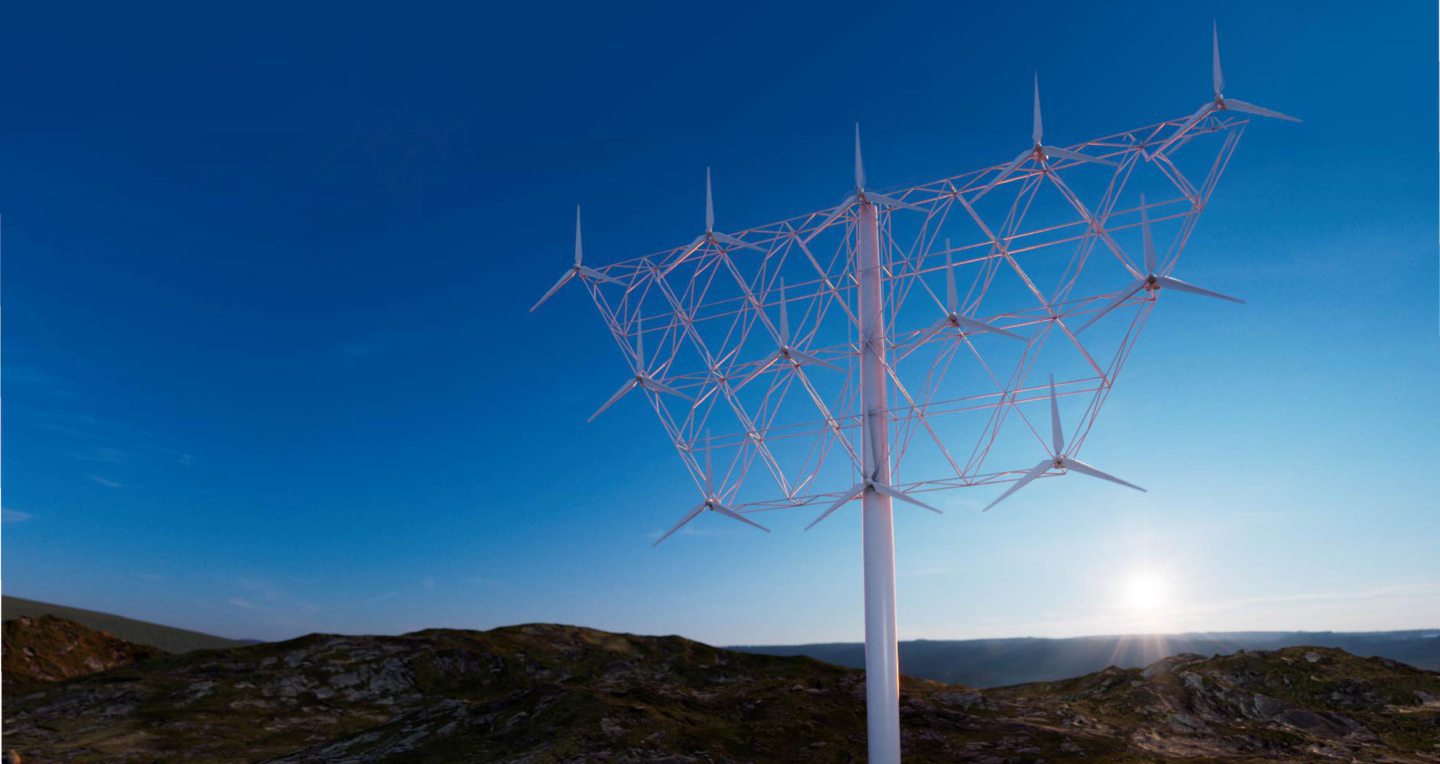
Myriad Wind Energy Systems is an award-winning Scottish cleantech startup developing revolutionary multi-rotor modular wind turbines designed to make clean energy more accessible and cost-effective for rural businesses, farms, distilleries, and data centres. Founded in 2021 and headquartered in Stirling, Scotland, the company secured £865,000 in seed funding in December 2025 led by TRICAPITAL Angels, with participation from Scottish Enterprise, SFC Capital, and South East Angels.
The Myriad Turbine addresses fundamental limitations of conventional single-rotor wind turbines by using numerous smaller, standardised rotors mounted within a modular lattice framework. This innovative design eliminates the need for specialist transport, massive cranes, and dedicated access roads, dramatically reducing capital costs and installation complexity whilst unlocking thousands of previously unsuitable wind sites across the United Kingdom and beyond.
The Founding Team: PhD Researchers Turned Entrepreneurs
Adam Harris: Chief Executive Officer and Co-Founder
Adam Harris serves as CEO and co-founder of Myriad Wind Energy Systems, bringing a unique combination of renewable energy research credentials, business acumen, and entrepreneurial drive. Harris graduated with an engineering degree from the University of Strathclyde before completing his PhD in Magnetic Gearing for Renewable Energy at the University of Edinburgh in July 2024.
Before founding Myriad, Harris served as Finance Manager at the International Network on Offshore Renewable Energy (INORE), an organisation promoting collaboration in the renewable energy sector. This role provided valuable insights into the business side of renewable energy whilst building connections across the global wind industry.
Harris’s journey to entrepreneurship began during his PhD programme at the Wind and Marine Energy Systems Centre for Doctoral Training, where he met his co-founders in 2017. His keen eye for commercial opportunities combined with technical expertise positioned him perfectly to lead Myriad’s mission to fundamentally reshape how wind energy reaches distributed generation markets.
In interviews, Harris has articulated the problem Myriad addresses with clarity: “Winter energy costs are crippling for rural businesses, and solar simply doesn’t deliver when they need it most. There’s massive demand for local clean energy that works year-round, but traditional small-wind has been held back by poor economics and installation complexity.”
Harris has led Myriad through multiple successful fundraising rounds, won pitch competitions including the Green Pitch Showcase, and represented the company at industry events worldwide. His combination of technical knowledge, business skills, and tenacity has proven essential in building Myriad from concept to commercial deployment.
Paul Pirrie: Chief Technology Officer and Co-Founder
Paul Pirrie serves as Chief Technology Officer and co-founder, leading technology development at Myriad. Pirrie completed his PhD at the University of Strathclyde with research focused specifically on multi-rotor wind turbine technology, making him one of the world’s leading specialists in this emerging field. His doctoral work provided the technical foundation for Myriad’s patented design approach.

Pirrie’s background in mechanical and design engineering proves essential for translating research concepts into manufacturable products. He has worked extensively with SOLIDWORKS 3D CAD modelling software to develop and refine Myriad’s turbine designs, using finite element analysis to assess structural integrity and optimise material usage whilst maintaining performance.
As CTO, Pirrie explains Myriad’s core innovation: “We’re developing what’s called a multi-rotor wind turbine. The idea is to have lots of small rotors on one structure instead of having one giant rotor.” His technical leadership ensures Myriad’s designs not only work on paper but can be manufactured cost-effectively and deployed reliably in real-world conditions.
Pirrie’s meticulous approach to engineering has helped Myriad secure two granted patents protecting the company’s intellectual property. He continues driving technology development whilst working closely with manufacturing partners to prepare for scaled production.
Peter Taylor: Chief Operating Officer and Co-Founder
Peter Taylor serves as Chief Operating Officer and co-founder, bringing expertise in offshore wind farm layout optimisation from his PhD research at the University of Strathclyde. Taylor’s background in optimising the placement and configuration of wind turbines within farms provides valuable insights into maximising energy capture whilst minimising costs.
As COO, Taylor focuses on operational excellence, ensuring Myriad develops structured approaches to product development, risk management, and commercial deployment. He has worked with engineering consultancy Blackfish Engineering on verification and validation (V&V) workshops, helping Myriad deconstruct its complex system into manageable subsystems, identify technical risks, and devise cost and resource-efficient mitigation strategies.
Taylor describes the value of this structured approach: “What we’re trying to do is such a huge undertaking and taking that structured approach from Blackfish’s V&V workshop and running with it has really helped us reduce costs and ultimately reduce our time to a minimum viable product.”
Team Growth and Culture
All three co-founders met in 2017 at the start of their PhD programme at the Wind and Marine Energy Systems Centre for Doctoral Training, a joint programme between the University of Edinburgh and University of Strathclyde. This shared academic background created strong working relationships and complementary skill sets that have proven essential for Myriad’s success.
The founders are also committee members of the International Network of Offshore Renewable Energy (INORE), maintaining connections to cutting-edge research and industry developments whilst promoting collaboration in the renewable energy sector.
Since formal incorporation in August 2021, the team has grown from three co-founders to five team members, with plans for continued expansion as the company moves from technology development into commercial deployment. The company culture emphasises rigorous engineering, commercial focus, and commitment to making wind energy accessible to markets currently underserved by conventional technology.
Revolutionary Technology: The Myriad Multi-Rotor Turbine
Core Design Innovation
The Myriad Turbine fundamentally reimagines wind turbine architecture by replacing the conventional single massive rotor with numerous smaller, standardised rotors mounted on a modular lattice framework. This approach addresses multiple limitations of traditional wind turbine designs simultaneously.
Conventional wind turbines have grown increasingly large over recent decades, with offshore turbine capacities now exceeding 20 megawatts and blade lengths surpassing 100 metres. Whilst this scaling delivers efficiency gains for utility-scale wind farms, it creates prohibitive logistics, installation, and maintenance challenges for distributed generation applications serving individual businesses, farms, or small communities.
Myriad’s multi-rotor approach reverses this trend, using proven scaling relationships that reduce material costs on key components like blades whilst maintaining or improving overall energy capture. The design philosophy focuses on simple components that are easy to manufacture, transport, install, and maintain, unlocking economic viability for thousands of sites where conventional small wind turbines prove impractical.
Transportability and Installation Advantages
One of Myriad’s most significant innovations lies in designing all components to fit on standard heavy goods vehicles (HGVs). This seemingly simple constraint delivers enormous practical benefits that fundamentally change the economics of wind energy deployment.
Traditional wind turbine blades for even modest-sized turbines exceed the dimensions of standard transport vehicles, requiring specialist oversized load transport. Harris notes that organising transportation for a hundred-megawatt onshore wind farm in the UK can take up to 12 months, requiring individual agreements and compensation for every landowner whose property the blades pass over or near.
Harris recounts speaking with a developer in England whose project stalled because turbines were “literally one inch away” from scraping buildings on the route to the site. These constraints eliminate thousands of potential wind sites from consideration before any other factors are evaluated.
By fitting all components on standard HGVs, Myriad eliminates these transportation bottlenecks. Sites accessible by normal freight vehicles suddenly become viable for wind energy deployment. This dramatically expands the addressable market for distributed wind generation.
Installation advantages prove equally significant. Conventional wind turbines require massive specialist cranes, with larger models demanding some of the world’s biggest mobile cranes. These cranes are expensive, have limited availability, and require substantial ground preparation and access roads capable of supporting their weight.
Myriad’s crane-free installation approach uses the modular lattice structure itself as the installation framework, with smaller rotors lifted into position using far more accessible equipment. This reduces installation costs, minimises site disruption, shortens installation timelines, and enables deployment in locations where bringing massive cranes proves impossible or economically prohibitive.
Built-In Redundancy and Reliability
The multi-rotor configuration provides inherent redundancy that conventional single-rotor turbines cannot match. If one rotor experiences a fault or requires maintenance, the remaining rotors continue generating power. This contrasts sharply with traditional turbines where any significant fault stops all generation until repairs are completed.
Combined with an efficient maintenance system enabled by smaller, more accessible components, the Myriad Turbine produces more power, more of the time, improving the capacity factor (the percentage of time the turbine operates at full output) compared to conventional small wind installations.
The redundancy also reduces the commercial risk for customers. With traditional turbines, extended downtime for repairs or parts availability can eliminate months of expected revenue. Myriad’s design ensures that even with one or more rotors offline, the system continues delivering substantial power output, maintaining cash flow whilst repairs proceed.
Aerodynamic and Performance Benefits
Whilst the logistical and reliability advantages of multi-rotor designs are readily apparent, Myriad has also optimised the aerodynamic configuration to enhance energy capture compared to single-rotor equivalents.
The company’s research background in multi-rotor wind turbine technology has enabled the team to leverage beneficial aerodynamic interactions between rotors. When configured correctly, multiple rotors can actually capture more total energy than an equivalent single rotor covering the same swept area, due to complex wake interactions and pressure field effects.
These aerodynamic gains, combined with the improved maintenance and reliability characteristics, lead to significant improvements in annual energy yield compared to conventional small wind turbines with similar nameplate capacity.
Sustainable Materials and Circular Economy
Myriad’s design philosophy extends beyond performance and economics to environmental sustainability throughout the product lifecycle. The smaller rotors enable development of sustainable blade materials combined with sustainable manufacturing and recycling processes.
Conventional large wind turbine blades present recycling challenges, with most decommissioned blades currently ending up in landfills despite being manufactured from composite materials that could theoretically be recovered. The sheer size and complex composite construction make practical recycling economically challenging with current technologies.
Myriad’s smaller blades open possibilities for more sustainable materials and end-of-life management. The company believes wind turbines should not only produce clean power but also utilise a fully circular economy to reach all sustainability goals. This commitment positions Myriad as a leader not just in wind energy deployment but in truly sustainable renewable energy solutions.
Funding Journey: From Academic Spin-Out to Commercial Deployment
Early Support and Validation
Myriad Wind Energy Systems registered as a company in August 2021, immediately following the founders’ success winning the Conception X Accelerator DemoDay competition. Conception X, a deep-tech startup accelerator, provided the initial springboard for transforming academic research into commercial opportunity, offering mentorship, network access, and early validation.
In 2022, Myriad secured a £50,000 Innovate UK grant to increase engagement across the renewable energy sector and further develop its wind turbine design. The company also secured a test site in Ayrshire where it planned to operate a prototype within the following few years. These early milestones demonstrated progress from concept to tangible development whilst building credibility with potential investors and customers.
Additional support came from Scottish innovation programmes including Venture Kick, which provided early-stage non-dilutive funding during the spin-out phase from university research. These grants enabled Myriad to develop initial designs, file patent applications, and begin engaging with potential manufacturing partners and customers.
Seed Funding Round: £865,000 to Accelerate Commercial Deployment
In December 2025, Myriad Wind Energy Systems announced the close of a £865,000 seed funding round, representing a critical milestone in the company’s evolution from technology development to commercial deployment. TRICAPITAL Angels, a leading Scottish angel investment network, led the round with participation from Scottish Enterprise, SFC Capital, and South East Angels.
Moray Martin, Chief Executive of TRICAPITAL Angels, explained the investment rationale: “Myriad is addressing a global challenge with clear commercial potential. Small wind has been a missing piece of the decentralised energy puzzle, and we believe Myriad has the technology and team to lead this emerging market. What excites us is the combination of strong intellectual property, a differentiated engineering solution and a clear route to market.”
Derek Shaw, Director of Entrepreneurship and Investment at Scottish Enterprise, noted the investment aligned with the agency’s focus on supporting energy transition technologies with export potential: “The energy transition is one of Scotland’s most exciting economic opportunities. Myriad’s technology has significant commercial potential to support businesses in becoming more sustainable and less reliant on fossil fuels.”
The seed funding will support several critical priorities as Myriad moves from technology development into commercial deployment:
Commercial and Engineering Team Expansion: Hiring additional engineers to accelerate product development, commercial staff to engage potential customers and secure pilot deployments, and operations personnel to establish manufacturing partnerships and supply chain relationships.
First-of-a-Kind Prototype Deployment: Building and deploying the planned 50kW prototype scheduled for installation in 2026, validating technology performance in real-world conditions, and demonstrating reliability to potential customers and investors.
Manufacturing and Supply Chain Partnerships: Securing relationships with manufacturing partners capable of producing Myriad’s components at scale, establishing supply chain for materials and sub-components, and preparing for volume production to support commercial deployments.
Development Roadmap and Future Funding
Myriad has established an ambitious but achievable roadmap for scaling its technology from prototype to commercial deployment:
2026: Installation of 50kW prototype demonstrating core technology in operational conditions, collecting performance data to validate design assumptions, and proving installation methodology.
2027: Construction of 1MW 10-rotor demonstrator showcasing scaled system capabilities, followed by commercial pilot deployments with early customers under letters of intent already secured.
2028 and Beyond: Full commercial launch with volume manufacturing, expansion across UK distributed wind market, and eventual international expansion including offshore and floating wind applications.
This roadmap will require additional funding beyond the seed round. The company expects to pursue Series A financing in 2026 or 2027 to support scaled manufacturing, commercial deployment, and market expansion. The seed round success and continued progress toward milestones position Myriad well for subsequent funding at attractive valuations.
Target Markets and Applications
Rural Businesses and Farms
Rural businesses represent Myriad’s initial primary target market, addressing urgent energy needs that current solutions serve inadequately. Harris articulates the problem clearly: “Winter energy costs are crippling for rural businesses, and solar simply doesn’t deliver when they need it most.”
Agricultural operations, food and beverage producers, rural manufacturing, and other businesses in remote locations face high energy costs due to grid infrastructure limitations whilst also experiencing the greatest wind resources. However, conventional small wind turbines have largely failed to deliver economic returns due to high capital costs, installation complexity, and reliability issues.
Myriad targets these underserved customers with a proposition combining lower capital cost through simplified logistics and installation, higher reliability through redundancy reducing lost revenue from downtime, and year-round generation complementing solar installations that produce little power during winter months when heating and lighting demands peak.
Scottish distilleries present a particularly attractive application. These businesses consume substantial energy for heating and process requirements, operate in rural locations with excellent wind resources, and face increasing pressure to improve sustainability credentials. Several distilleries have expressed interest in Myriad’s technology, with letters of intent secured for pilot deployments.
Data Centres and Industrial Estates
Data centres represent an enormous and growing energy demand, with artificial intelligence workloads driving exponential increases in power requirements. Whilst hyperscale data centres typically locate near grid infrastructure, edge computing facilities and smaller data centres often operate in locations where additional grid capacity proves expensive or unavailable.
Myriad’s technology enables on-site wind generation for these facilities, reducing grid dependency, improving energy security, and supporting sustainability goals. The modularity of Myriad’s system allows capacity to scale with facility requirements, starting with smaller installations and adding capacity as computing demands grow.
Industrial estates with multiple businesses sharing infrastructure present another attractive application. A Myriad installation can serve multiple tenants, with power purchase agreements allocating energy and costs appropriately. This shared infrastructure model improves project economics whilst providing clean energy to businesses that could not justify dedicated renewable installations.
Off-Grid and Remote Infrastructure
Telecommunications towers, remote monitoring stations, and other off-grid infrastructure currently rely on diesel generators or expensive grid connections. Myriad’s transportability enables wind generation deployment to sites inaccessible to conventional turbines, providing clean, reliable power that eliminates ongoing fuel costs and reduces maintenance requirements compared to diesel generators.
Islands and remote communities represent additional opportunities where grid connections prove expensive and energy security concerns motivate local generation. Myriad’s modular approach allows systems scaled appropriately for community requirements, with potential for staged deployment as budgets allow.
Future Markets: Offshore and Floating Wind
Looking beyond distributed generation, Myriad sees long-term opportunities in offshore and floating wind applications. The challenges driving utility-scale turbines to ever-larger sizes also create vulnerabilities that multi-rotor approaches could address.
Harris notes that current offshore turbine manufacturers face huge order backlogs, with increases in raw materials costs and supply-demand mismatches leading to price increases up to 35% over four years. Manufacturing techniques remain “very expensive”, with single blades taking up to 14 days to produce.
Myriad’s approach of building larger numbers of smaller standardised components enables manufacturing automation and efficiency gains impossible with massive custom components. The company estimates its design can reduce capital expenditure costs by 10% for a 6MW wind turbine, whilst simplified manufacturing processes could dramatically reduce production bottlenecks.
Competitive Advantages and Market Position
Intellectual Property Protection
Myriad holds two granted patents protecting its core technology, creating barriers to entry for potential competitors. These patents cover the modular framework design, rotor configuration approaches, and installation methodology that enable the crane-free deployment and logistical advantages central to Myriad’s value proposition.
Strong intellectual property protection proves essential for deep-tech startups like Myriad, which invest substantially in research and development before generating revenue. The patents provide defensive moats against larger competitors whilst potentially creating licensing revenue opportunities as the market develops.
Manufacturing and Supply Chain Strategy
Myriad’s focus on standardised, relatively simple components creates significant manufacturing advantages. Harris notes that Myriad’s 13-metre blades could be manufactured by any company building fibreglass hulls for sailing yachts, dramatically expanding the potential manufacturing partner base compared to conventional turbine blades requiring specialist facilities.
This manufacturing accessibility enables Myriad to source UK manufacturing for blades and frames, increasing local content, reducing supply chain risk, and potentially accessing favourable treatment from customers prioritising domestic manufacturing. The strategy also enables rapid scaling as standardised components allow volume manufacturing without constantly redesigning for each new project.
Commercial Traction and Validation
Myriad has secured multiple letters of intent from prospective customers, providing crucial validation that the technology addresses real market needs. These commitments enable the company to demonstrate commercial traction to investors whilst providing potential revenue visibility supporting financial projections.
The company has won multiple awards recognising its innovation and potential impact, including the Sustainability Initiative of the Year award at the Stirling Business Excellence Awards. These accolades provide credibility whilst generating publicity that attracts additional customers and partners.
Also Read: BIOWEG: Leadership, Funding, and the Biotech Replacing Petrochemicals
Challenges and Critical Success Factors
Technology Validation and Performance
Whilst Myriad has developed sophisticated models and built a 2kW proof-of-concept demonstrator, the planned 50kW prototype in 2026 represents a critical validation milestone. The prototype must demonstrate that real-world performance matches theoretical predictions, reliability meets commercial requirements, and installation methodology works as designed.
Any significant technical challenges discovered during prototype operation could delay commercialisation timelines or require design modifications that increase costs or reduce performance. However, the founders’ deep technical backgrounds and rigorous engineering approach minimise these risks.
Manufacturing Scale-Up
Moving from prototype to commercial production requires establishing manufacturing partnerships and supply chains capable of delivering components at volume with consistent quality and acceptable costs. Myriad must prove that theoretical manufacturing advantages translate to practical reality as production scales.
The standardised nature of components and use of proven manufacturing techniques reduce execution risk compared to more exotic technologies. However, any supplier quality issues or capacity constraints could impact deployment timelines and customer commitments.
Market Development and Customer Acquisition
Distributed wind represents an underdeveloped market in the UK and globally, with most potential customers having limited experience with on-site wind generation. Myriad must educate potential customers, demonstrate economic returns, and overcome scepticism based on poor experiences with earlier small wind technologies that often underperformed expectations.
Early pilot deployments succeeding commercially will prove essential for building confidence and generating word-of-mouth marketing within target industries. Conversely, any high-profile failures or performance shortfalls could damage market perception and slow adoption.
The Path Forward: Transforming Distributed Wind
Myriad Wind Energy Systems stands positioned to fundamentally transform how wind energy serves distributed generation markets. The company’s technology addresses real barriers that have prevented small wind from achieving its potential, offering a credible path to making on-site wind generation economically attractive for thousands of rural businesses, farms, and other energy consumers across the UK and internationally.
The seed funding round provides resources to execute on critical near-term milestones, particularly the 50kW prototype deployment in 2026 and commercial pilots in 2027. Success with these milestones will validate the technology, demonstrate commercial viability, and position Myriad for scaled deployment serving the massive untapped market for distributed wind generation.
The team’s combination of deep technical expertise, commercial focus, and entrepreneurial drive creates confidence that Myriad can execute on its ambitious vision. With strong intellectual property protection, supportive investors aligned with the company’s mission, and clear market demand evidenced by letters of intent from prospective customers, Myriad has assembled the essential elements for transforming a promising technology into a successful commercial venture.
As energy costs continue rising, climate concerns intensify, and energy security becomes increasingly important, the need for accessible, reliable, year-round renewable generation solutions grows more urgent. Myriad Wind Energy Systems offers a compelling answer to these challenges, positioned to unlock wind energy’s potential for markets that conventional technology cannot serve economically.
Also Read: Lila Sciences: Building the World’s First Scientific Superintelligence Platform