

What Is Physical Intelligence?
Physical intelligence is a term used in two distinct but increasingly connected domains. In human performance, it refers to the ability to understand and manage the body to improve cognitive clarity, resilience, confidence, and decision making. In robotics and artificial intelligence, physical intelligence describes the capability of machines to perceive, reason, and act effectively in the unstructured physical world.
This article focuses on physical intelligence in robotics, specifically the San Francisco based startup Physical Intelligence, which is building general purpose AI foundation models that enable robots to understand and interact with real world environments. Often denoted as π, Physical Intelligence is applying the foundation model paradigm to robotics, much like large language models transformed text based AI.
Founded in 2024, Physical Intelligence has raised $1.1 billion in total funding and reached a valuation of approximately $5.6 billion by November 2025, making it one of the most well funded and closely watched companies in physical intelligence robotics.
Physical Intelligence Robotics Explained
Physical intelligence robotics refers to AI systems that can generalise across tasks, environments, and robot hardware without being explicitly programmed for each scenario. Traditional robots operate in tightly controlled settings and fail when faced with unexpected variation. Physical Intelligence aims to overcome this limitation by developing a single generalist brain capable of controlling many robots across many tasks.
The company builds vision language action models that combine visual perception, natural language understanding, and continuous motor control. These models allow robots to follow plain language instructions, adapt to new environments, and perform complex manipulation tasks such as folding laundry, cleaning kitchens, or assembling boxes.
Unlike classical robotics pipelines that separate perception, planning, and control, Physical Intelligence robotics systems learn end to end from large scale real world data, enabling smoother, more flexible, and more human like behaviour.
Also Read: PhysicsX: The AI-Powered Engineering Platform Revolutionising Industrial Design
Physical Intelligence Founder and Leadership Team
The Physical Intelligence founding team brings together some of the most influential researchers in modern robotics and reinforcement learning, combining academic excellence with industry experience.
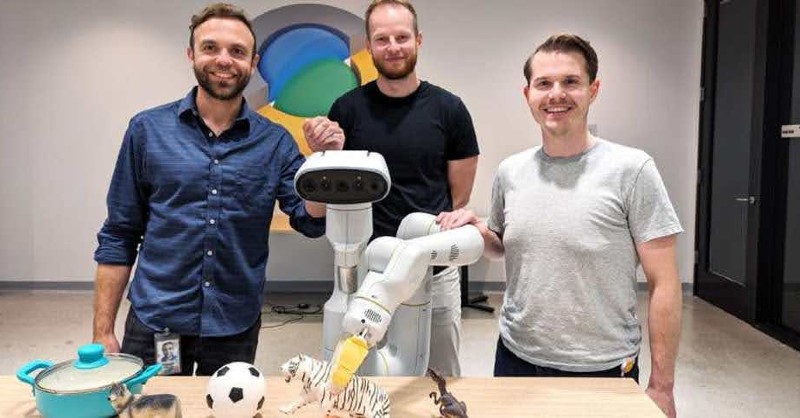
Karol Hausman, Physical Intelligence CEO
Karol Hausman is the CEO and co founder of Physical Intelligence. Prior to founding the company, he was a Staff Research Scientist at Google DeepMind and an adjunct professor at Stanford University, where he co taught CS 224R on deep reinforcement learning.
Hausman has spent over a decade working on general purpose robot learning, focusing on enabling robots to acquire skills that transfer across environments and hardware platforms. His work directly informs Physical Intelligence’s core mission of building a single generalist intelligence for any robot. As Physical Intelligence CEO, Hausman has articulated a long term vision of universally embodied AI that can operate in the real world with minimal human intervention.
Sergey Levine, Chief Scientist and Co Founder
Sergey Levine serves as Chief Scientist and Physical Intelligence founder. He is also an associate professor at the University of California, Berkeley, where his lab pioneered deep reinforcement learning methods for robotic manipulation and control.
Levine’s research contributions include sim to real transfer, learning from human demonstrations, and scalable robot learning algorithms. At Physical Intelligence, he guides the scientific direction of the foundation models, ensuring they scale in capability and generalisation rather than remaining confined to narrow tasks.
Chelsea Finn, Research Lead and Co Founder
Chelsea Finn is a Physical Intelligence founder and Research Lead, while also serving as an associate professor at Stanford University. Her work on meta learning, particularly Model Agnostic Meta Learning, has shaped how robots can rapidly adapt to new tasks with minimal data.
Finn’s expertise is critical to Physical Intelligence’s ability to generalise across diverse environments, allowing robots trained in one setting to perform effectively in entirely new ones.
Additional Physical Intelligence Founders
Other Physical Intelligence founders include Brian Ichter, formerly of Google Research, who contributes expertise in motion planning and robot learning, and Lachy Groom, a former Stripe executive and technology investor who brings operational and commercial leadership. Additional founding members Quan Vuong and Adnan Esmail contribute deep experience in reinforcement learning and robotics engineering.
Physical Intelligence Technology and Foundation Models
Physical Intelligence is best known for its work on general purpose robot foundation models, particularly the π series of vision language action systems.
π0 Foundation Model
Released in February 2025, π0 is Physical Intelligence’s first generalist robot policy. It is a three billion parameter transformer model built on top of PaliGemma and extended with robot state and action generation modules.
The π0 model uses flow matching to generate smooth, continuous action trajectories at high frequency, enabling precise and dexterous manipulation. It was trained on over ten thousand hours of real world robot data spanning seven robot embodiments and sixty eight tasks. This scale allows strong zero shot performance and efficient fine tuning on new tasks.
Physical Intelligence open sourced the π0 code and weights, establishing it as a reference point for the broader physical intelligence robotics community.
π0 FAST and Action Tokenisation
In November 2025, the firm introduced π0 FAST, an autoregressive vision language action model using the Flow matching Action Space Tokenizer. This approach compresses continuous actions into discrete tokens using the Discrete Cosine Transform, dramatically accelerating training and inference.
π0 FAST enables approximately five times faster training than diffusion based approaches while maintaining the precision required for real world manipulation. The pretrained weights and tokenizer were released open source, reinforcing Physical Intelligence’s leadership in robot foundation model research.
π0.5 and Open World Generalisation
π0.5 represents a major step forward in physical intelligence robotics. Unlike earlier models that operate primarily within training like environments, π0.5 demonstrates meaningful generalisation to entirely new homes, offices, and layouts.
This capability is achieved through co training on heterogeneous data sources, including multiple robots, semantic predictions, and web data. Physical Intelligence demonstrated π0.5 cleaning unseen homes, folding unfamiliar laundry, and organising objects based on contextual understanding rather than explicit rules.
RECAP Learning Framework
They trains its robots using RECAP, short for Reinforcement Learning with Experience and Corrections via Advantage conditioned Policies. This framework combines human demonstrations, real time coaching, and autonomous reinforcement learning.
RECAP allows robots to continuously improve from experience while incorporating human feedback when mistakes occur. Physical Intelligence reported significant improvements in task throughput and reliability compared to imitation learning alone, particularly on complex manipulation tasks.
Physical Intelligence Funding and Investors
Physical Intelligence funding reflects strong investor conviction in the future of the company.
Seed and Series A Funding
The company raised a $70 million seed round in March 2024, followed by a $400 million Series A in November 2024, valuing the company at approximately $2.4 billion. Investors included OpenAI, Jeff Bezos, Thrive Capital, Lux Capital, Sequoia Capital, and Khosla Ventures.
Series B Funding at $5.6 Billion Valuation
In November 2025, Physical Intelligence raised $600 million in Series B funding led by CapitalG, with participation from Lux Capital, Bond, Redpoint Ventures, Sequoia Capital, T. Rowe Price, and NVIDIA through NVentures. This round brought total Physical Intelligence funding to $1.1 billion and established a valuation of approximately $5.6 billion.
The capital is being used to expand data collection, scale compute infrastructure, grow research and engineering teams, and establish partnerships with robotics manufacturers and enterprise customers.
Physical Intelligence Robotics Use Cases
PI robotics systems have demonstrated capabilities across a wide range of real world tasks.
Household and Service Robotics
Demonstrations include cleaning kitchens and bedrooms in unseen homes, folding laundry, organising objects, making beds, and following complex natural language instructions. These tasks highlight the adaptability required for home environments, which are among the most unstructured settings robots face.
Industrial and Logistics Applications
In manufacturing and logistics, Physical Intelligence models show promise for assembly, packaging, machine tending, warehouse picking, and material handling tasks that involve high variability and frequent change.
Competitive Landscape in Physical Intelligence Robotics
The company competes with other companies building robot foundation models, including Skild AI, Covariant, 1X Technologies, Sanctuary AI, and Dyna Robotics. Major technology companies such as Google DeepMind, Tesla, Amazon, and Boston Dynamics also pursue advanced robotics research.
What differentiates Physical Intelligence is its focus on software first generalist foundation models rather than vertically integrated hardware platforms, positioning it as a potential foundational layer for the broader robotics ecosystem.