

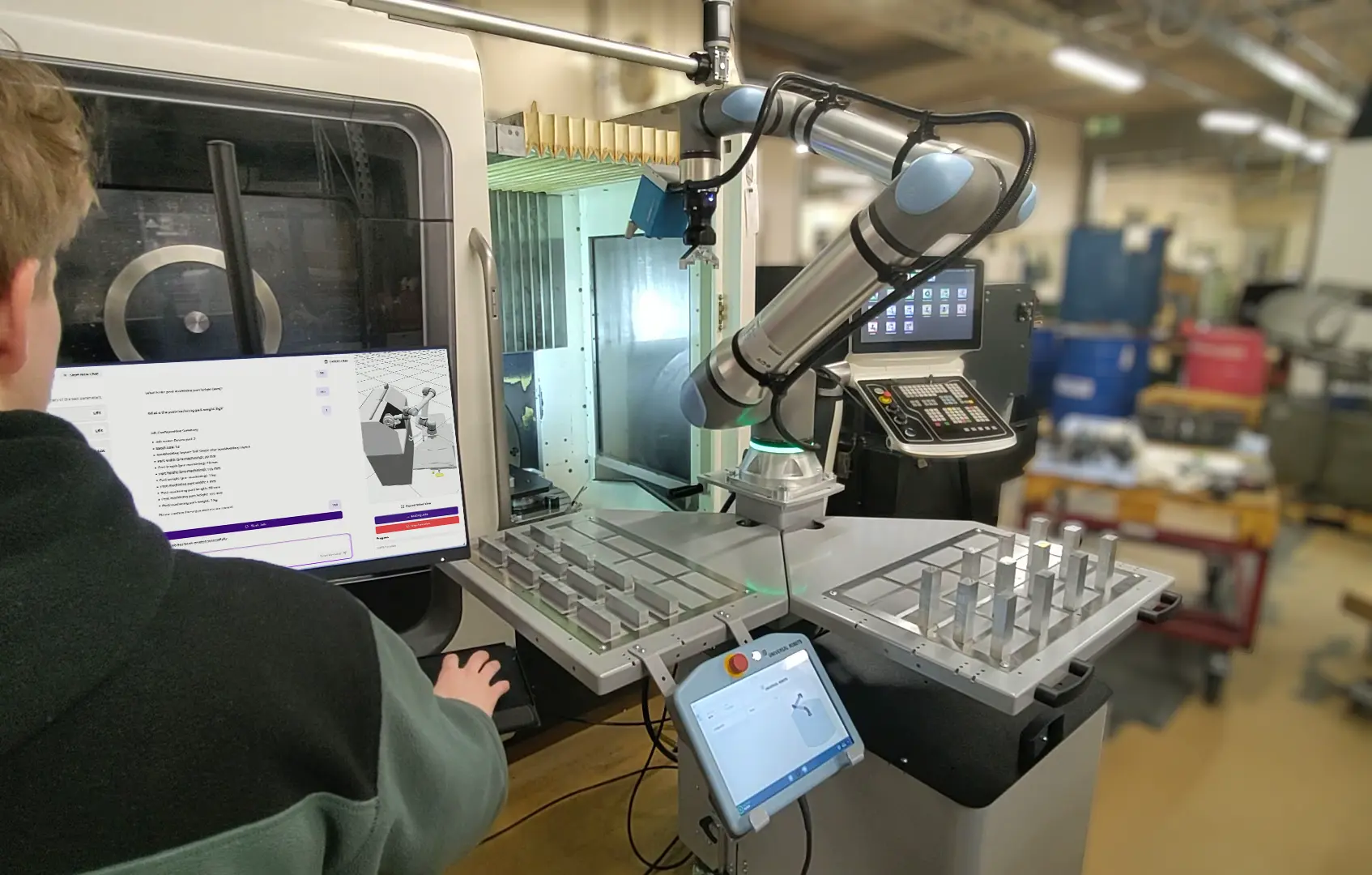
Trener Robotics’ Acteris platform enables industrial robots to learn tasks through conversation rather than complex programming. Image: Trener Robotics
What is Trener Robotics?
Trener Robotics is a Norway and US-based startup developing “Physical AI” software that transforms industrial robots from programmed machines into adaptive, learning systems. Founded in 2024 by Dr Asad Tirmizi and Dr Lars Tingelstad, the company has raised €26 million ($32 million) in Series A funding co-led by Engine Ventures and IAG Capital Partners, with participation from strategic investors including Nikon through its NFocus Fund. The company’s Acteris platform allows manufacturers to program robots using natural language conversation rather than complex code, reducing deployment time and enabling robots to handle variable, unstructured production environments.
The funding brings Trener’s total capital to over €38 million and will accelerate development of T-Labs, the company’s research division, while expanding global talent acquisition and market presence. The company operates dual headquarters in San Francisco and Trondheim, Norway, combining Silicon Valley AI expertise with European industrial robotics heritage.
The Problem: Why 90% of Industrial Robots Remain “Dumb”
Despite decades of automation, the industrial robotics market faces a fundamental paradox: robots are ubiquitous yet underutilised. Over 3 million robotic arms operate in factories worldwide, yet 90% perform only repetitive, single-purpose tasks in highly controlled environments. The reason is not mechanical limitation but programming complexity.
Traditional industrial robots require “point-to-point” programming, where engineers manually code each movement, waypoint, and action sequence. This process can take weeks for complex tasks and demands specialised expertise that most manufacturers lack. When production changes, new parts arrive, or layouts shift, robots must be reprogrammed from scratch, creating downtime and cost.
The result is a massive installed base of “dumb” automation, expensive hardware limited by brittle software. Manufacturers face a choice: invest heavily in custom integration for each application, or leave robots idle during product transitions. This is the problem Trener Robotics calls “dynamic complexity,” the gap between robotic capability and practical deployment.
The Solution: Conversational Programming and Physical AI
Trener Robotics’ Acteris platform addresses this gap through what the company terms “Physical AI,” artificial intelligence systems that perceive, decide, and act in real-world manufacturing environments. Unlike traditional robotics software or digital AI that analyses data without physical interaction, Physical AI creates a closed loop between sensors, AI models, and robotic actuation.
The platform’s core innovation is conversational programming. Rather than writing code, operators describe tasks in plain language, such as “pick up the metal bracket from the conveyor, inspect for defects, and place good parts in the blue bin.” Acteris translates these instructions into executable automation using pre-trained skill models for manipulation, vision, and motion planning.
These skill models represent another key differentiation. Instead of learning from scratch for each deployment, Acteris applies expert-trained models for specific tasks like machine tending, assembly, or quality inspection. The models are trained on visual, haptic, language, and action data, enabling robots to handle variation, adapt to changing parts, and operate safely alongside humans.
Key capabilities include:
- Agentic Interface: Natural language programming with high-fidelity simulation, enabling non-technical users to build applications
- Adaptive Vision: Part identification and handling under adverse conditions, including varying lighting and object positioning
- Intelligent Motion: Real-time path optimisation that responds to environmental changes with collision avoidance
- Production Intelligence: Real-time dashboards for performance monitoring and continuous improvement
The Founders: From Google Acquisition to Norwegian Academia
Trener Robotics’ founding team combines deep technical expertise with rare commercial insight. CEO Dr Asad Tirmizi spent over a decade in robotics research, including positions at Flanders Make (Belgium’s manufacturing research institute), Vicarious (the AI robotics company acquired by Google in 2022), and ByteDance’s robotics and haptics programme. He holds a PhD in Robotics and Haptics from Università di Siena, where he received the top doctoral dissertation award from the Italian Society of Researchers in Automatic Control.
CTO Dr Lars Tingelstad brings complementary expertise from academia and industry. He served as Associate Professor of Robotic Production at the Norwegian University of Science and Technology (NTNU) from 2018 to 2024, heading the Robotics Group and focusing on optimisation and 3D geometry for industrial applications. His academic background in mechatronics and automation engineering provides the theoretical foundation for Trener’s control systems.
This combination, Tirmizi’s experience in Silicon Valley AI labs and Tingelstad’s European industrial robotics research, positions Trener to bridge the gap between AI innovation and manufacturing deployment. The founders have assembled a team with experience from Universal Robots, ABB, KUKA, Autodesk, and TikTok, creating unusual depth for a company just two years old.
Market Context: The €158M European Robotics Wave
Trener’s funding arrives amid sustained capital deployment into European robotics and industrial AI. In 2025-2026, adjacent companies raised approximately €158 million across the sector, indicating robust investor appetite for automation infrastructure:
- Germany’s RobCo secured €100 million for modular AI-driven manufacturing systems
- Switzerland’s Flexion raised €43 million for reinforcement learning in humanoid robotics
- Poland’s Nomagic raised €8.3 million (following €41.5 million earlier in 2025) for AI-driven warehouse operations
- Germany’s SEAL Robotics raised €1.7 million for container logistics automation
- London’s Neuracore secured €2.5 million for unified robot-learning infrastructure
- Switzerland’s Forgis raised €3.8 million for industrial machine automation
This activity reflects a broader shift from “automation” to “intelligent autonomy.” Where previous generations of industrial robots followed fixed programs, the new wave employs AI for perception, reasoning, and adaptation. The AI-powered industrial robot market reached $16.8 billion in 2025 and is projected to grow at 7.1% CAGR through 2035, according to Global Market Insights.
Trener’s specific focus on “Physical AI” and conversational programming positions it within the fastest-growing segment: software-defined robotics that reduces deployment friction and expands addressable use cases beyond high-volume, unchanging production runs.
Strategic Investors: Engine, Nikon, and the Physical AI Thesis
The Series A investor syndicate reflects strategic alignment around the Physical AI opportunity. Engine Ventures, the Cambridge, Massachusetts-based firm co-leading the round, has established expertise in hard tech and robotics. The firm previously backed T-robotics (Trener’s former name) at seed stage and has portfolio companies in energy storage (Form Energy), AI accelerators (Rise Robotics), and industrial automation.
Reed Sturtevant, General Partner at Engine Ventures, who led the seed investment, notes: “When we co-led Trener Robotics’ Seed round, we saw a team with a clear vision to solve one of automation’s biggest bottlenecks. Their execution and ability to rapidly scale has been remarkable. This traction positions Acteris as the intelligence layer for physical automation.”
Nikon Corporation’s participation through its NFocus Fund is particularly significant. The $51.5 million fund, established in August 2024 in partnership with Geodesic Capital, targets early to mid-stage startups in robotics, space, carbon neutral technologies, energy, and bio/healthcare. Nikon is the anchor limited partner, with the fund managed by Geodesic Capital, a firm founded by former US Ambassador to Japan John Roos to bridge Silicon Valley and Japanese corporate innovation.
For Nikon, Trener represents a bet on the “intelligence layer” for industrial automation, complementing Nikon’s existing optical and precision manufacturing expertise. The Japanese industrial giant’s Vision 2030 aims to create “a global society where humans and machines co-create seamlessly,” making robotics software a strategic priority.
Other participants include IAG Capital Partners, Cadence, Geodesic Capital, Shanda Ventures, Emergent Ventures, Fitz Gate Ventures, Techable VC, Radius Capital Ventures, and Raisewell Ventures, creating a diverse syndicate spanning deep tech, corporate venture, and geographic regions.
Competitive Positioning: Beyond Traditional Robotics
Trener Robotics operates in a crowded field but with distinct positioning:
Traditional Robot Manufacturers (ABB, FANUC, KUKA, Yaskawa): These giants dominate hardware but are retrofitting AI onto legacy platforms. Their strength is mechanical reliability and global service networks; their weakness is software agility and ease of deployment.
Collaborative Robot (Cobot) Specialists (Universal Robots, Techman Robot): These companies focus on safe human-robot interaction but still require traditional programming for complex tasks. Universal Robots has launched AI Accelerator toolkits integrating NVIDIA Isaac libraries, indicating convergence toward Trener’s approach.
AI-First Robotics Startups (Standard Bots, Symbotic, Figure AI): These companies target specific applications (warehouse automation, humanoid logistics) with integrated hardware-software solutions. Trener differentiates by being robot-agnostic, working across brands rather than selling its own hardware.
Vertical Software Players (RobCo, Nomagic): These companies offer complete automation solutions for specific industries. Trener provides the intelligence layer that could enable such companies, positioning as infrastructure rather than application.
Trener’s robot-agnostic approach is critical. By supporting ABB, Universal Robots, and FANUC through a unified software layer, the company avoids competing with hardware manufacturers while capturing value from the shift toward software-defined automation. This “Intel Inside” strategy for industrial robotics reduces customer lock-in and expands addressable market.
Traction and Validation: From ABB Challenge to EMO Award
Despite its youth, Trener has achieved significant industry validation. In 2024, the company won the ABB AI Startup Challenge, a global competition seeking innovation in natural language programming, skill learning, and autonomous decision-making. As a winner, Trener gained collaboration rights with ABB to reduce programming time while ensuring optimal performance across manufacturing scenarios, with first commercial applications expected in 2025.
In autumn 2024, Trener won the Machine Tool Innovation Award at EMO Hannover, the world’s largest machining trade show. The award recognised the company’s “groundbreaking approach to robotics” and the industry’s shift “away from complex, code-heavy programming toward an AI-driven model where robots can learn, adapt, and perform complex tasks with human-like intuition.”
Commercial traction includes partnerships with over 15 solutions and integration partners across Europe and the US. The company targets both underutilised robots (difficult to reprogram or maintain) and new installations through OEM and system integrator channels, a dual strategy that maximises market penetration while reducing customer acquisition costs.
The Roadmap: T-Labs and Global Expansion
The €26 million funding supports four strategic priorities:
T-Labs R&D: Expanding the research division to develop new skill models, improve Physical AI capabilities, and advance the state of the art in robot learning
Skill Training: Building out the library of pre-trained models for specific manufacturing tasks, reducing time-to-value for new deployments
Talent Acquisition: Hiring AI researchers, robotics engineers, and application specialists across San Francisco and Trondheim
Market Expansion: Scaling partner relationships and direct sales in Europe and North America
The dual headquarters structure reflects Trener’s transatlantic strategy. San Francisco provides access to AI talent, venture capital, and early-adopter customers in technology manufacturing. Trondheim offers proximity to European industrial customers, lower operational costs, and access to NTNU’s robotics research ecosystem. Norway’s startup ecosystem grew 22.7% in 2025, with over $1.2 billion in total funding, indicating robust support for deep tech ventures.
Conclusion: The ChatGPT Moment for Robotics
At CES 2026, NVIDIA CEO Jensen Huang declared: “The ChatGPT moment for robotics is here. Breakthroughs in physical AI, models that understand the real world, reason and plan actions, are unlocking entirely new applications.”
Trener Robotics is betting that this moment extends beyond demonstration to industrial deployment. The company’s conversational programming interface, pre-trained skill models, and robot-agnostic architecture address the fundamental barriers that have kept 90% of industrial robots confined to repetitive tasks.
Whether Trener can achieve the platform dominance it envisions depends on execution: scaling the skill library, maintaining performance across diverse hardware, and navigating the complex sales cycles of industrial manufacturing. The competition from established robot manufacturers and well-funded AI startups is intense.
But the strategic validation from Engine Ventures, Nikon, and industry awards suggests Trener has identified a genuine market need. For manufacturers struggling with labour shortages, reshoring pressures, and the complexity of traditional automation, the promise of robots that can be programmed through conversation and adapt to variation is compelling. The €26 million Series A provides the capital to prove that Physical AI can move from research concept to shop-floor reality.
For the European tech ecosystem, Trener represents a new model: Norwegian academic research combined with Silicon Valley AI expertise, funded by transatlantic venture capital, targeting global industrial markets. As the line between software and physical automation blurs, such hybrid companies may define the next generation of industrial technology.
Also Read: Former MI5 officer raises €2.3M for AI agent security startup Overmind