

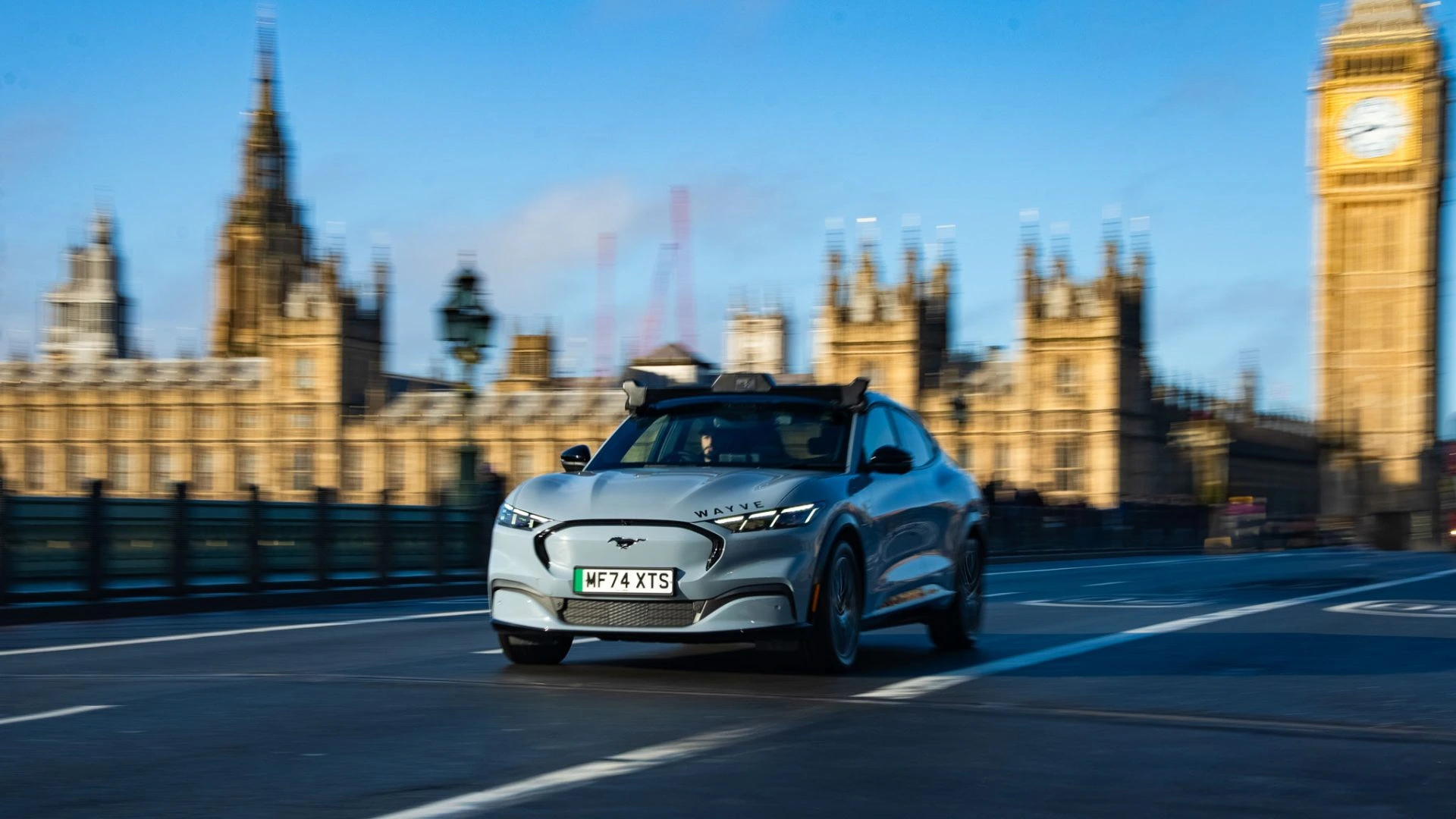
London-based autonomous driving company Wayve has raised $1.2 billion in a Series D funding round, bringing its valuation to $8.6 billion and positioning it among the most highly valued artificial intelligence companies in Europe. The funding marks a major transition for the company, accelerating its move from research-led innovation to large-scale commercial deployment of its embodied AI platform across automakers and ride-hailing networks worldwide.
The round was led by Eclipse, Balderton Capital, and SoftBank Vision Fund 2, with participation from global institutional investors including Ontario Teachers’ Pension Plan, Baillie Gifford, British Business Bank, Icehouse Ventures, and Schroders Capital. Strategic investors Microsoft, NVIDIA, and Uber also participated, alongside major automotive manufacturers Mercedes-Benz, Nissan, and Stellantis.
This broad mix of financial, technology, and automotive investors highlights growing industry confidence in Wayve’s approach to autonomous driving, particularly its software-first model designed to enable global scalability.
What Wayve does and why it matters
Wayve develops embodied AI systems designed to enable autonomous driving across passenger vehicles, robotaxis, and commercial fleets. Its core product, known as the AI Driver, uses end-to-end machine learning to control vehicles directly from sensor inputs without relying on traditional rule-based programming or high-definition maps.
Unlike conventional autonomous driving systems that require detailed mapping and extensive manual engineering for each location, Wayve’s AI is trained on diverse driving data collected globally. This allows the system to generalise across cities and environments without needing location-specific adaptation.
This approach significantly reduces deployment complexity and enables faster scaling across different markets.
Key capabilities of Wayve’s AI Driver
Wayve’s autonomous driving platform enables:
- Hands-off driving capability under driver supervision (Level 2+)
- Future eyes-off autonomy in higher automation levels (Level 3 and Level 4)
- Real-time decision-making using onboard sensors and compute systems
- Operation without reliance on high-definition maps
- Adaptability across different vehicle models and geographies
These capabilities allow automakers to integrate autonomous driving functionality into vehicles using software rather than complex hardware and mapping infrastructure.
Funding breakdown and strategic investors
The $1.2 billion Series D round reflects strong backing from leading investors across technology, mobility, and financial sectors.
Venture capital and institutional investors
The round was led by:
- Eclipse
- Balderton Capital
- SoftBank Vision Fund 2
Additional investors include:
- Ontario Teachers’ Pension Plan
- Baillie Gifford
- British Business Bank
- Icehouse Ventures
- Schroders Capital
These investors provide long-term capital to support Wayve’s global expansion and commercial deployment strategy.
Strategic technology partners
Major technology companies investing in Wayve include:
- Microsoft
- NVIDIA
- Uber
These partnerships provide access to cloud computing infrastructure, AI hardware acceleration, and global mobility platforms.
Automotive manufacturer investments
Leading global automakers have also invested directly in Wayve, including:
- Mercedes-Benz
- Nissan
- Stellantis
These investments reflect automaker confidence in Wayve’s software as a core component of future vehicle platforms.
Leadership and founding team
Wayve was founded in 2017 by Alex Kendall, who serves as CEO. Kendall, a researcher with a background in computer vision and machine learning, pioneered the application of end-to-end deep learning to autonomous driving.
Under his leadership, Wayve has evolved from a university research project into one of the world’s leading embodied AI companies. The company originated in Cambridge and has since expanded globally, attracting talent from artificial intelligence, robotics, and automotive engineering sectors.
Kendall’s vision focuses on building a general-purpose autonomous driving intelligence that can operate across vehicles, locations, and markets.
Technology innovation: embodied AI and foundation models
Wayve’s technology is built on embodied AI, which refers to artificial intelligence systems that learn by interacting with real-world environments.
The company has developed a foundation model trained on driving data from more than 70 countries. This model enables vehicles to interpret road environments, predict behaviour, and make driving decisions in real time.
One of Wayve’s major technical milestones is achieving zero-shot deployment across more than 500 cities. This means the system can operate in new locations without requiring additional training or manual adjustment.
This capability significantly reduces deployment time and enables global scalability.
Commercial deployment roadmap
Wayve’s funding will support commercial deployment across multiple channels, including passenger vehicles and autonomous ride-hailing fleets.
Robotaxi deployment with Uber
Wayve is partnering with Uber to deploy autonomous robotaxis powered by its AI Driver.
Key milestones include:
- Robotaxi trials launching in London in 2026
- Expansion into more than 10 global markets
- Uber operating fleets powered by Wayve’s AI software
This partnership provides a scalable model for autonomous ride-hailing using mass-produced vehicles.
Consumer vehicle integration
Wayve’s AI Driver will begin appearing in consumer vehicles from 2027.
Initial capabilities include:
- Hands-off driving under driver supervision
- Automated steering and navigation
- Continuous software improvement through AI learning
Over time, higher levels of autonomy will be introduced.
Business model and scalability advantage
Wayve licenses its autonomous driving software directly to automakers rather than manufacturing vehicles itself.
This approach offers several advantages:
- Lower capital requirements compared to vertically integrated competitors
- Faster global deployment through existing automaker distribution networks
- Compatibility with multiple vehicle brands and platforms
- Continuous software improvement without hardware redesign
This licensing model positions Wayve as a foundational software provider for the global automotive industry.
Market opportunity and industry context
The total addressable market for autonomous driving includes passenger vehicles, commercial fleets, logistics, and ride-hailing services.
Wayve’s platform is designed to operate across all vehicle categories, creating opportunities for large-scale deployment.
The combination of AI-driven autonomy, partnerships with major automakers, and integration into mobility platforms creates a pathway to widespread adoption.
As automakers increasingly shift toward software-defined vehicles, platforms like Wayve’s AI Driver are expected to become essential components of future vehicle systems.
How Wayve will use the funding
The new funding will support several strategic priorities:
Commercial deployment
Scaling partnerships with automakers and mobility platforms.
Research and development
Advancing AI models to improve safety, performance, and scalability.
Global expansion
Expanding operations across Europe, North America, and Asia.
Infrastructure scaling
Supporting computing infrastructure needed to train and deploy AI models.
Why this funding is significant
Wayve’s $1.2 billion funding round is one of the largest investments in autonomous driving AI globally. It reflects growing confidence in embodied AI as the foundation for scalable autonomous driving.
The company’s partnerships with major automakers, technology providers, and mobility platforms position it to play a central role in the future of transportation.
By focusing on software rather than hardware-heavy infrastructure, Wayve offers a scalable pathway to autonomous driving that can be deployed globally.
FAQs
How much funding did Wayve raise?
Wayve raised $1.2 billion in a Series D funding round, bringing its valuation to $8.6 billion.
What does Wayve do?
Wayve develops AI software that enables autonomous driving using end-to-end machine learning.
Who invested in Wayve?
Investors include SoftBank Vision Fund 2, Eclipse, Balderton Capital, Microsoft, NVIDIA, Uber, Mercedes-Benz, Nissan, and Stellantis.
What is Wayve’s AI Driver?
Wayve’s AI Driver is software that enables vehicles to drive autonomously using AI trained on real-world driving data.
When will Wayve’s autonomous vehicles be available?
Robotaxi trials begin in 2026, and consumer vehicles with Wayve AI are expected from 2027.
Also Read: Thema secures $6.2M funding to transform private equity expansion strategy with AI