

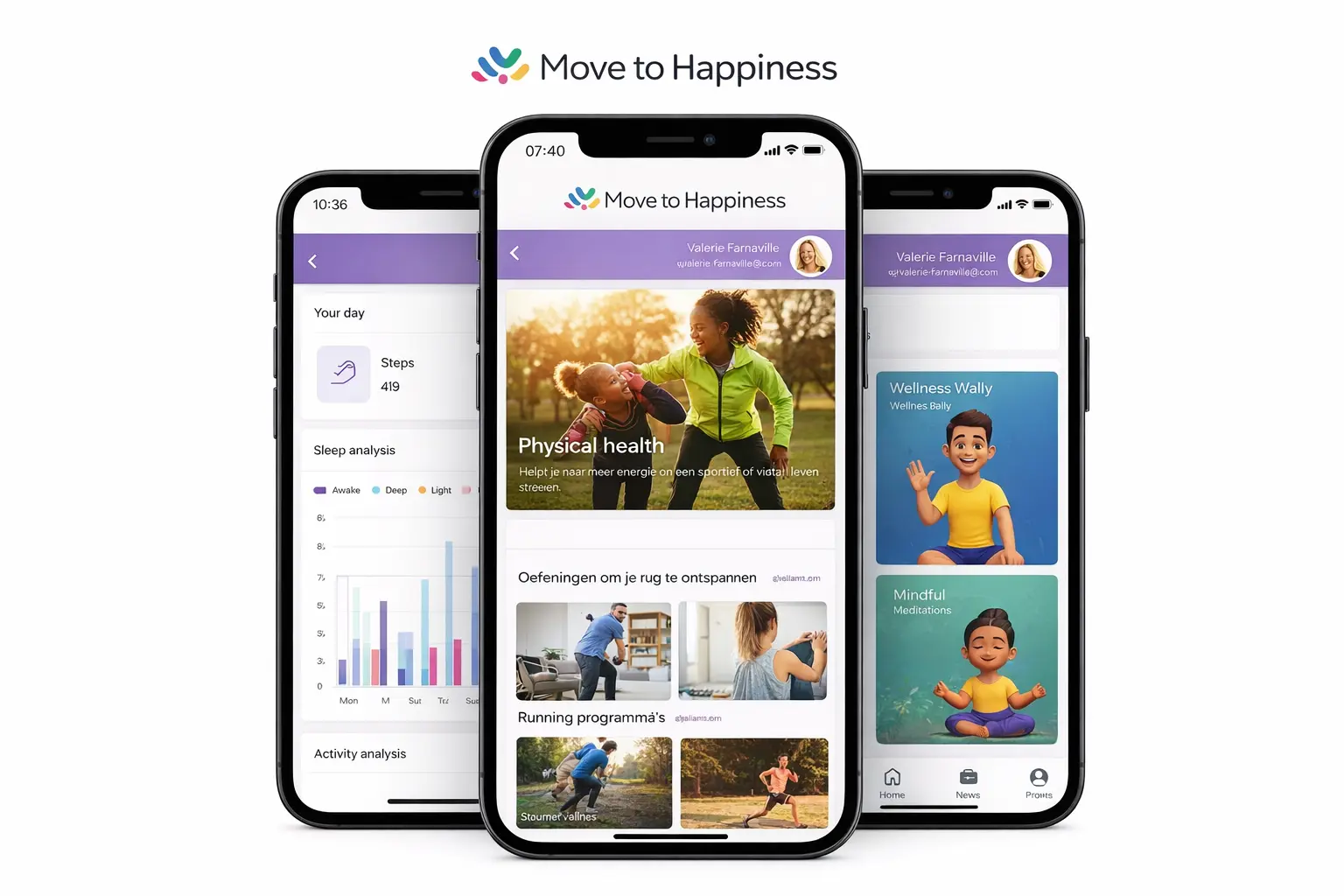
Antwerp-based HRTech company Move To Happiness has raised €1 million in funding to accelerate the development and rollout of its Human Performance platform, an AI-driven system designed to structurally connect employee wellbeing with productivity and business outcomes.
The funding will be used to further refine the company’s AI infrastructure, enhance early detection of performance and burnout risks, and scale the platform across organisations operating in high-pressure environments.
From wellbeing initiatives to measurable performance
Founded in 2021, Move To Happiness positions itself at the intersection of wellbeing, behavioural science and organisational performance. Rather than treating wellbeing as a standalone benefit, the company focuses on how factors such as energy, focus, recovery and mental sharpness directly influence day-to-day performance and long-term organisational results.
“Wellbeing is still too often approached as care or compensation,” says Kenneth Van Daele, CEO and co-founder of Move To Happiness. “But at its core, this is about how people function in complex environments. Their energy, focus, recovery and decision-making capacity now directly determine how teams and organisations perform.”
An AI infrastructure for human performance
Move To Happiness’ platform combines objective physiological data, including sleep patterns, stress indicators, heart rate variability and energy levels from wearables, with personality and behavioural profiles. These inputs are analysed using evidence-based behavioural science models and translated into personalised guidance delivered through specialised AI coaches.
The AI coaches focus on areas such as sleep optimisation, mental load management, energy regulation and daily behavioural choices. According to the company, this personalised approach enables support to be delivered at scale without relying on one-to-one human coaching models.
A distinguishing feature of the platform is its dual-level insight. While employees receive individual, tailored guidance, organisations gain access to anonymised, aggregated insights that reveal structural patterns affecting performance. These include where energy is consistently lost, which teams or roles experience chronic recovery pressure, and which signals tend to precede burnout, disengagement or employee turnover.
Engagement rates above traditional wellbeing programmes
Move To Happiness reports that traditional corporate wellbeing initiatives typically achieve engagement rates of 20 to 40 percent. By contrast, the company says its platform sees 65 to 90 percent active participation among client organisations, suggesting stronger integration into daily work routines.
The platform is currently used by organisations including Accenture and Belgian professional services firm VGD, with use cases spanning performance improvement, burnout prevention and retention support.
Positioned within a growing European HRTech market
The €1 million round comes amid sustained investment in European HRTech companies focused on AI-enabled people management, skills intelligence and performance optimisation. Over the past two years, more than €67 million has flowed into adjacent segments, including funding rounds for companies developing human capital management platforms, AI-native HR systems and skills-based workforce tools.
Within this landscape, Move To Happiness’ raise is modest in size but aligns with a broader shift towards data-driven approaches that explicitly connect human functioning and wellbeing to organisational performance and productivity.
According to the company, organisations are investing more than ever in wellbeing, yet burnout, mental fatigue and productivity loss continue to rise. The problem, says Van Daele, is not a lack of intent but a lack of structure.
Many initiatives remain disconnected from daily work reality, insufficiently account for individual differences, and rarely make the link between wellbeing and performance explicit. By embedding wellbeing into operational decision-making and performance management, Move To Happiness aims to turn human energy and focus into measurable, manageable drivers of organisational success.
With its new funding in place, the company plans to expand its customer base, deepen its AI models and further position human performance as a core pillar of modern organisational strategy.
Also Read: Capalo AI secures €11M Series A to scale AI-powered virtual power plants across Europe