

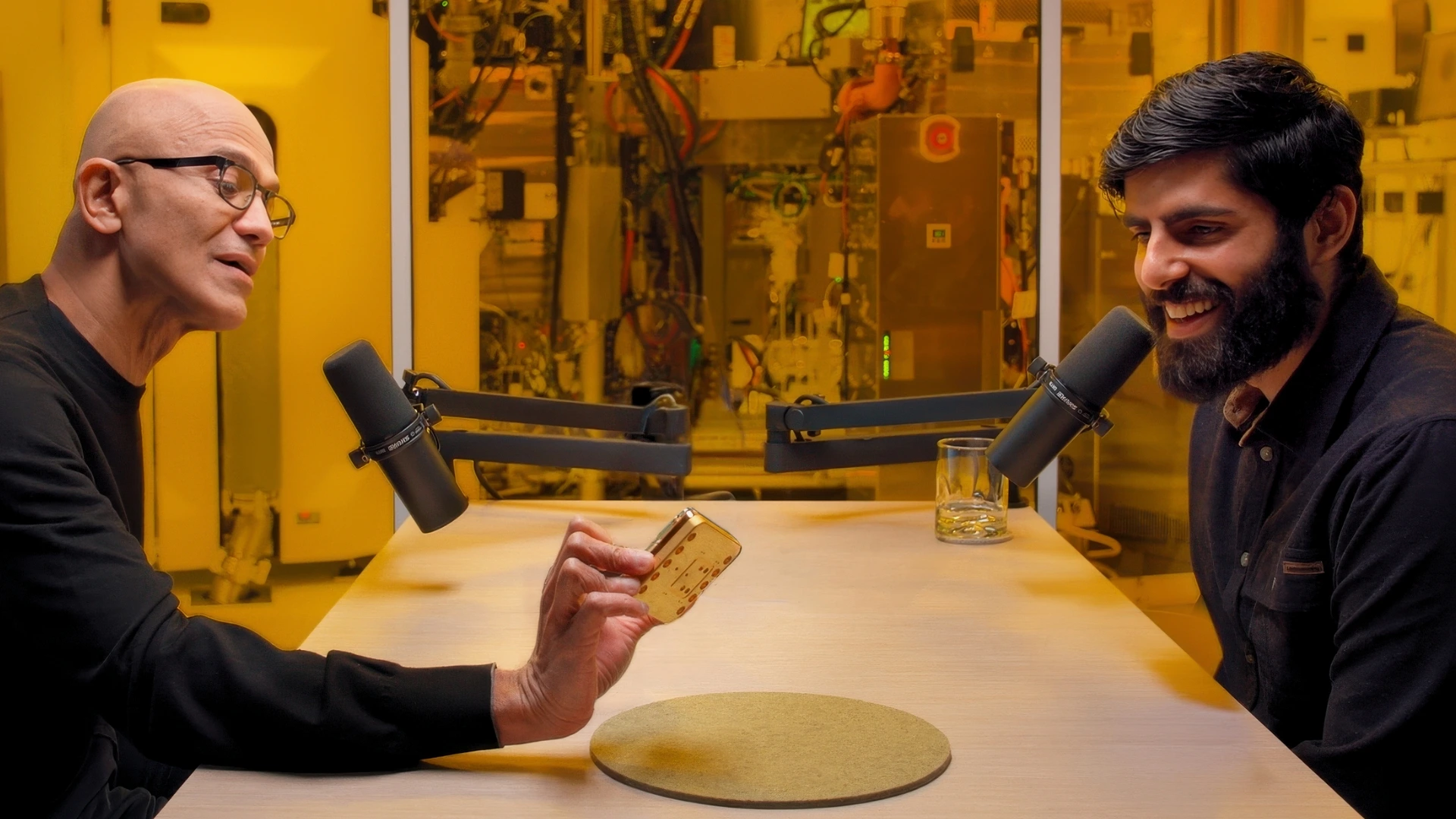
Who is Dwarkesh Patel?
Dwarkesh Patel (born 19 August 2000) is an American podcaster, writer, and technology journalist best known for the Dwarkesh Podcast and his 2025 book The Scaling Era: An Oral History of AI, 2019–2025. A University of Texas at Austin computer science graduate and KU Leuven researcher, Patel has established himself as the primary oral historian of the artificial intelligence revolution, conducting deeply researched interviews with Mark Zuckerberg, Satya Nadella, Demis Hassabis, Dario Amodei, and Ilya Sutskever. His work focuses on the technical foundations of large language models, AI scaling laws, and the societal implications of artificial general intelligence (AGI).
The Making of a Tech Oral Historian
Patel’s path to becoming Silicon Valley’s most sought-after interviewer began in movement, not stability. Born in India, he relocated to the United States at age nine when his father, a physician on an H1-B visa, accepted positions in rural communities across North Dakota, West Virginia, Maryland, and Texas. This peripatetic childhood cultivated the intellectual adaptability that now defines his interviewing style: the ability to enter unfamiliar domains, rapidly acquire expertise, and ask questions that reveal hidden assumptions.
At the University of Texas at Austin, Patel studied computer science under Scott Aaronson, the quantum computing theorist and 2024 ACM Prize recipient. He graduated in December 2021 with technical foundations in computational theory and machine learning. Yet unlike peers who pursued engineering roles at major technology firms, Patel found himself drawn to what he calls “the pursuit of interesting ideas”- a trajectory that led him to KU Leuven in Belgium, where he conducted research on the intersection of artificial intelligence and human biomechanics before committing to journalism full-time.
Early Life and Formative Influences
Patel spent his early years in India before moving to the United States at around age nine. His father, a doctor on an H1-B visa, worked in rural communities where medical demand was high. The family relocated frequently across states such as North Dakota, West Virginia, Maryland, and Texas. These transitions exposed Patel to varied environments and perspectives. The constant adaptation helped build the intellectual agility and resilience that now define his interviewing style.
Dwarkesh Patel Education and Academic Foundation
Graduating from the University of Texas at Austin in December 2021 with a degree in computer science, Patel developed strong technical grounding in computational theory and artificial intelligence. Studying under professors such as Scott Aaronson further equipped him to discuss cutting-edge research with depth and precision.
Despite enjoying programming, Patel found himself increasingly drawn to reading, writing, and intellectual exploration. He realised he valued pursuing interesting ideas over following conventional career paths, a decision that would shape his trajectory as a podcaster and writer.
The Dwarkesh Podcast: Methodology and Growth
Launched in 2020 from his college dormitory during the COVID-19 pandemic, the podcast began modestly. Patel secured his first significant interview by emailing economist Bryan Caplan to express appreciation for The Case Against Education. Caplan responded, and the resulting conversation established a template: exhaustive preparation, technical depth, and willingness to challenge premises.
The podcast’s growth has been organic, driven by substance rather than marketing. As of January 2026, the Dwarkesh Podcast has published approximately 115 episodes and accumulated over 63,000 Substack subscribers. Patel’s guest list now reads as a directory of AI’s architects: Anthropic CEO Dario Amodei, OpenAI co-founder Ilya Sutskever (in both his only and second-ever podcast appearances), Google DeepMind co-founder Demis Hassabis, Microsoft CEO Satya Nadella, Meta CEO Mark Zuckerberg, and former UK Prime Minister Tony Blair.
Launch of the Dwarkesh Podcast
Patel began his podcasting journey during the COVID-19 pandemic, launching what began as the Lunar Society Podcast from his college dorm room. His first notable interview came after he emailed economist Bryan Caplan to share appreciation for his book. Caplan responded, and Patel took the opportunity to request an interview. From that point, Patel continued reaching out to influential thinkers, steadily building a reputation for thoughtful preparation.
His guest list has since expanded to include Mark Zuckerberg, Satya Nadella, Andrej Karpathy, Ilya Sutskever, Dario Amodei, Demis Hassabis, Tony Blair, and Patrick Collison. These conversations have grown his audience organically, driven not by marketing but by the substance and clarity of his interviews.
Also Read: Dylan Patel and SemiAnalysis
A Methodology Built on Depth and Precision
Patel stands out for his extensive preparation. Before interviewing AI researchers, he often reads their recent papers, implements exercises from technical work, and consults experts to understand nuanced concepts. This allows him to ask questions that uncover insights other interviewers may overlook.
His Substack newsletter attracts tens of thousands of readers, and his interviews are widely shared across the technology community. Researchers and industry leaders appreciate his ability to synthesise technical material into clear, structured discussions.
Integrating Artificial Intelligence into the Research Process
Patel is known for using AI tools to accelerate his learning. He employs large language models for spaced repetition, conceptual clarification, and cross-referencing research. His approach reflects a broader trend toward augmenting human expertise with AI, and Patel openly shares how these tools help him prepare for complex interviews.
By incorporating AI into his workflow early, Patel demonstrates how researchers and journalists can use new technologies to enhance understanding and productivity.
The Scaling Era: Critical Reception and Impact
In October 2025, Stripe Press published Patel’s first book, The Scaling Era: An Oral History of AI, 2019–2025, co-authored with Gavin Leech. The work compiles curated excerpts from Patel’s interviews, organised thematically around scaling laws, model internals, alignment, input constraints, and economic impact. It includes over 170 technical definitions and visualisations, functioning simultaneously as primary source document and educational resource.
The critical reception has been substantial. Jeff Dean, Google’s Chief Scientist, endorsed the volume, while Goodreads reviewers praised its “unprecedented access” to AI’s founding generation. The book achieved particular resonance within the effective altruism and rationalist communities for its unvarnished treatment of existential risk. One reviewer described it as “Silicon Valley Confidential for the AI age,” noting that Patel’s subjects “confess more to him than to Congress.”
However, the reception was not uniformly positive. Critics noted the oral history format’s inherent limitations-fragmentary narrative structure and elite bias toward Silicon Valley perspectives. Others argued that the knowledge cutoff (November 2024) meant the book underplayed 2025’s regulatory and safety developments. Nevertheless, as a historical document capturing the mindset of AI’s architects during the critical 2019–2025 period, the book has few competitors.
Recognition and Impact
In 2024, Time listed Patel among the 100 most influential people in artificial intelligence. His work spans disciplines such as history, economics, geopolitics, genetics, and philosophy, demonstrating intellectual range and depth.
Patel regularly interviews experts significantly older and more established than he is, approaching conversations with confidence and humility. His focus remains on helping audiences understand complex developments in artificial intelligence and their broader societal implications.
The Scaling Era: Documenting a Transformative Period
In 2025, Patel and coauthor Gavin Leech published The Scaling Era: An Oral History of AI, 2019 to 2025 with Stripe Press. The book compiles interviews and analysis from leading researchers, offering context on the development of large language models, AI safety debates, and the rapid evolution of modern AI systems.
Endorsed by prominent figures such as Jeff Dean, the book serves as an accessible resource for readers seeking to understand how present AI systems were built and where the field may be heading.
Effective Communication Through Direct Outreach
Patel’s career also illustrates the value of effective communication. His cold emails have secured interviews with influential individuals, including Satya Nadella, who joined the podcast after receiving a concise message complimenting the show.
Patel advises aspiring interviewers to demonstrate genuine engagement, research their guests thoroughly, and present compelling questions that reflect thoughtful preparation.
The “Learning Athlete” Model and Podcasting’s Future
Patel’s emergence coincides with broader shifts in technology media. Traditional journalism has struggled to match the technical depth required to interrogate AI researchers effectively, while many podcasters prioritise personality over preparation. Patel occupies a middle ground: sufficiently technical to engage specialists, sufficiently clear to educate generalists.
In a January 2026 reflection on podcasting as “professional learning,” Patel articulated his selection criteria: “I choose guests not based on whether I want to spend two hours chatting with them, but whether I would learn a lot by spending two weeks preparing.” This inversion of typical podcasting logic, where entertainment value precedes educational value, explains both his slow output (approximately 20–24 interviews annually) and their high impact.
The model has attracted institutional attention. In January 2026, GMO’s research division cited Patel alongside Lex Fridman and the All-In Podcast as primary influencers shaping AI investment sentiment, noting that “platforms such as X, TikTok, Facebook, and Substack are flooded with content about AI, made by AI, or both,” with Patel’s work representing a signal amid noise.
Looking Ahead: Patel’s Evolving Role in AI Discourse
As artificial intelligence continues to advance rapidly, Patel’s work offers a clear and structured resource for individuals seeking to understand the implications of new technologies. He provides nuanced discussions rather than promotional narratives, making his content particularly valuable for readers and listeners seeking clarity.
Based in San Francisco, he remains close to the centre of AI research and development. His ongoing interviews, articles, and analysis contribute to the public understanding of the technologies shaping global society.
What’s Next: The Post-Scaling Era
As of early 2026, Patel faces the question that defined his book: what follows the scaling era? His December 2025 interview with Sutskever suggested 2026 would inaugurate a new research phase focused on algorithmic efficiency rather than brute computational scaling. Patel’s own trajectory appears similarly transitional.
Having established the oral history format for AI, he faces the challenge of maintaining relevance as the technology moves from laboratory curiosity to infrastructure. His January 2026 reading list, featuring works on nonlinear dynamics, chaos theory, and “Machines of Loving Grace”, suggests continued expansion beyond computer science into broader questions of technological society.
For the European technology ecosystem, Patel’s work offers a methodological model. His demonstration that rigorous preparation and technical depth can attract audiences traditionally served by generalist media suggests opportunities for similar approaches to quantum computing, biotechnology, and climate technology. The “learning athlete” concept, treating expertise acquisition as public performance – may prove particularly valuable as European deep tech seeks to communicate complex innovation to broader publics.