

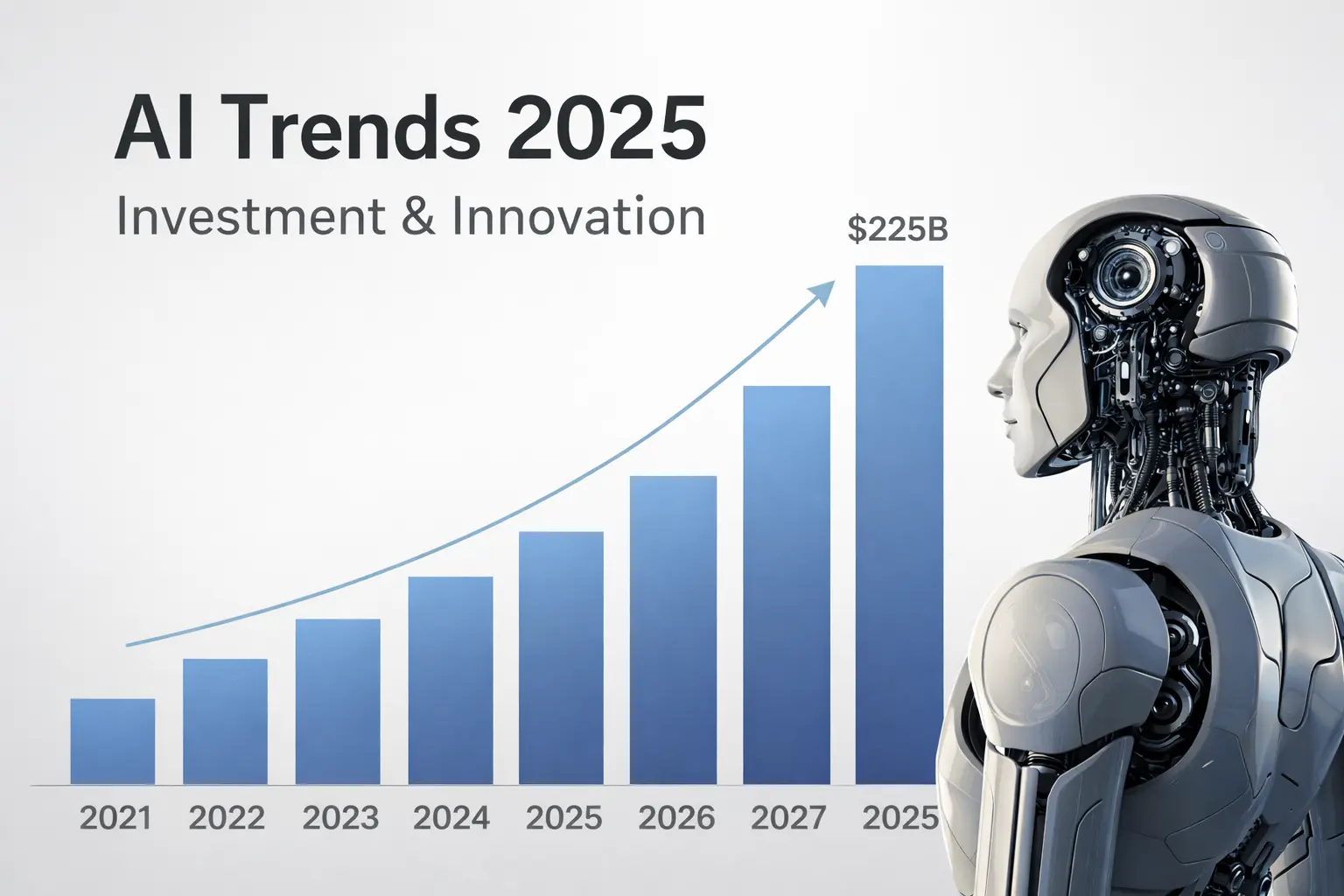
Artificial intelligence continues to reshape how businesses operate, how investors allocate capital and how new technology products reach the market. The AI trends 2025 report highlights a year where artificial intelligence moved from fast growth to large scale commercial impact. Funding reached historic highs, new technologies matured and competition intensified across every major sector.
This article presents a clear and practical breakdown of the AI trends 2025 report, explaining what changed in 2025, why it matters and how these developments are shaping the future of AI driven innovation.
What the AI Trends 2025 Report Reveals
The AI trends 2025 report shows three dominant patterns. AI funding surged to record levels, advanced language models continued to evolve rapidly and robotics emerged as one of the most active investment categories. Together, these trends confirm that AI is no longer experimental technology. It is now a core driver of global digital transformation.
Record AI Funding in 2025
One of the most striking findings in the AI trends 2025 report is the scale of investment flowing into artificial intelligence companies. Global private AI funding exceeded 225 billion dollars during the year, setting a new benchmark for the industry. While the total number of funding rounds declined slightly, the size of each investment increased, showing strong confidence in established AI players.
Investors focused their capital on companies with proven products, strong revenue potential and scalable infrastructure. This shift reflects a more mature market where financial performance and real world adoption matter as much as technical capability.
Growth of Large Language Models
Large language models remained at the centre of AI innovation in 2025. These systems now support customer service, software development, marketing, research and enterprise analytics. Continuous improvements in accuracy, reasoning and efficiency allowed organisations to deploy AI across a wider range of tasks.
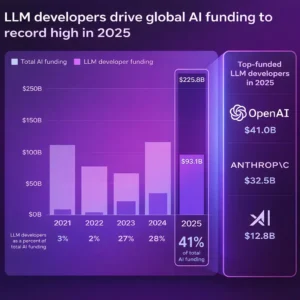
The AI trends 2025 report shows that investment in language model development is increasingly concentrated among a smaller number of companies with the resources to train and operate complex systems. At the same time, smaller firms are building specialised models designed for specific industries, including finance, healthcare and legal services.
Robotics and Physical AI Expansion
Robotics emerged as one of the fastest growing areas within artificial intelligence. AI powered robots are now being used in manufacturing, logistics, defence, healthcare and agriculture. These systems combine perception, planning and automation to operate in physical environments with minimal human input.
The AI trends 2025 report indicates that robotics startups accounted for the largest share of AI related deal activity. This growth highlights how artificial intelligence is extending beyond software into real world applications that deliver measurable operational value.
Key Technology Shifts Shaping AI in 2025
Several important technology shifts defined the AI landscape in 2025. These changes reflect how artificial intelligence is becoming more autonomous, more specialised and more deeply integrated into business systems.
Agentic AI Systems
Agentic AI refers to systems that can make decisions and take actions independently rather than simply generating content or recommendations. These systems can complete tasks, manage workflows and respond to changing conditions with limited human oversight.
The AI trends 2025 report shows growing adoption of agentic AI across customer support, operations management and enterprise software. Businesses are using these tools to reduce manual work, improve response times and increase productivity.
Domain Specific AI Solutions
While general purpose AI remains important, 2025 saw strong growth in domain specific AI solutions. These systems are trained and designed for particular industries, allowing them to deliver more accurate and reliable outcomes.
Healthcare is a clear example. AI tools are now assisting with diagnostics, clinical documentation, drug discovery and patient monitoring. By focusing on narrow but high impact use cases, domain specific AI delivers immediate value while meeting strict regulatory and quality standards.
Infrastructure and Data Platforms
Behind every successful AI system is robust infrastructure. Cloud computing, data pipelines and specialised hardware played a critical role in scaling AI throughout 2025. Organisations invested heavily in platforms that support model training, deployment and monitoring.
The AI trends 2025 report highlights increased demand for tools that help manage AI workloads, control costs and measure performance. As AI becomes embedded in everyday operations, reliable infrastructure is essential for long term success.
AI Investment and Market Dynamics
Investment patterns in 2025 reveal how the AI market is evolving from early stage experimentation to strategic consolidation.
Venture Capital Concentration
A significant portion of AI funding in 2025 came from large investment rounds. These mega rounds reflect investor belief that a smaller number of companies will dominate key AI categories. Capital is increasingly directed toward firms with strong competitive advantages, data access and distribution networks.
Mergers and Acquisitions Activity
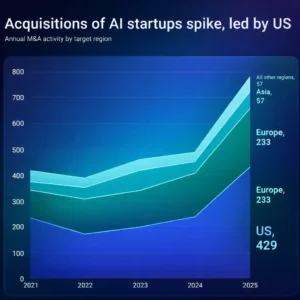
Mergers and acquisitions increased sharply during 2025 as established companies acquired AI startups to accelerate innovation and secure talent. This activity suggests that AI capabilities are now considered essential assets rather than optional enhancements.
Rise of AI Unicorns
The AI trends 2025 report shows that artificial intelligence companies accounted for most newly created unicorns during the year. These businesses demonstrated that AI can support sustainable growth, recurring revenue and global expansion.
Why AI Trends in 2025 Matter for Businesses
Understanding the AI trends 2025 report helps businesses make informed decisions about technology investment and strategy.
Enterprise AI Adoption
Enterprises are moving beyond pilot projects and embedding AI into core workflows. From predictive analytics to automated customer engagement, AI is delivering cost savings and performance improvements across multiple functions.
Building Long Term Competitive Advantage
Companies that invest early in AI capabilities gain long term advantages through efficiency, data driven insights and faster innovation cycles. As AI adoption becomes widespread, organisations without clear AI strategies risk falling behind competitors.
Frequently Asked Questions
How much funding did AI receive in 2025
Private AI companies raised more than 225 billion dollars globally in 2025, making it the highest funded year for artificial intelligence.
Why is robotics important for AI growth
Robotics brings AI into physical environments where automation delivers direct productivity gains. This makes robotics one of the most commercially valuable AI applications.
What is agentic AI
Agentic AI refers to systems capable of making decisions and performing tasks autonomously, reducing the need for constant human supervision.
Final Thoughts
The AI trends 2025 report confirms that artificial intelligence has entered a new phase of maturity. Investment is larger, applications are more practical and competition is more intense. Companies that understand these trends and act strategically are best positioned to benefit from the next wave of AI driven growth.
This analysis is based on data insights from CB Insights and aligns with ongoing coverage of future technology and innovation on EU Tech Future
Also Read: Czech-founded Mews hits $2.5B valuation after $300M EQT-led round