

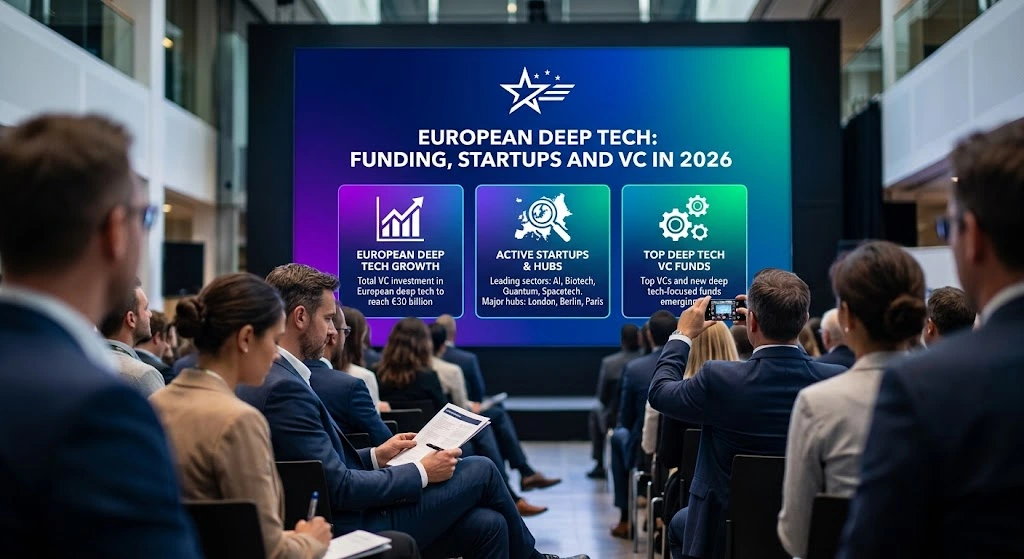
European deep tech has become a significant part of the continent’s venture capital market, with investment increasingly focused on artificial intelligence, advanced computing, defence, robotics, quantum technologies, energy, space and other science-based technologies.
In 2025, European deep tech startups raised $20.3 billion in venture capital, according to Dealroom’s European Deep Tech Report 2026. Deep tech accounted for 32% of all European VC funding, compared with 15% in 2015.
The market has continued to develop in 2026. Dealroom’s latest data puts European deep tech funding at $22.1 billion during the first six months of 2026, although this uses a broader deep tech classification than some other funding databases. Tech.eu recorded €1.9 billion across 100 deep tech rounds during the same period using a narrower sector classification.
These figures use different methodologies and should not be combined.
This article examines the European deep tech scene in 2026, covering deep tech funding, startups, investors, VC funds, AI funding, defence technology, quantum computing, robotics, European deep tech hubs, EIC funding, major funding rounds and funding by country.
European Deep Tech Funding in 2026
European deep tech covers a wide range of technologies, from artificial intelligence and quantum computing to robotics, advanced materials, defence systems and energy technologies.
Some of the key figures for the market include:
| Indicator | Latest figure | Period |
|---|---|---|
| European deep tech VC funding | $20.3bn | Full year 2025 |
| Deep tech share of European VC | 32% | 2025 |
| European deep tech VC funding | $22.1bn | H1 2026, Dealroom |
| European deep tech funding | €1.9bn | H1 2026, Tech.eu |
| European AI startup funding | $21.8bn | 2025 |
| European AI startup funding | €6.0bn | H1 2026 |
| European defence, security and resilience funding | $8.7bn | 2025 |
| European deep tech defence funding | $1.8bn | 2025 |
| EU quantum startup funding | Approximately €950m | 2025 |
| European robotics funding | €1.8bn | H1 2026 |
| EIC 2026 funding programme | More than €1.4bn | 2026 |
The differences between these figures reflect different definitions and datasets.
Dealroom’s broader deep tech classification covers a wide range of science and engineering companies, while Tech.eu applies its own sector classifications. The figures are therefore best used to understand the scale and direction of the market rather than as one combined European funding total.
What Is Deep Tech in Europe?
Deep tech generally refers to companies whose products or services depend substantially on scientific research, engineering, advanced technology or intellectual property.
Unlike many software businesses, deep tech startups often need to solve technical problems before reaching commercial scale. They may require laboratories, specialist equipment, manufacturing facilities, clinical development, semiconductor fabrication, computing infrastructure or other capital-intensive infrastructure.
European deep tech covers areas including:
- Artificial intelligence and advanced computing
- Quantum computing and quantum communications
- Robotics and autonomous systems
- Defence and dual-use technology
- Biotechnology and computational biology
- Advanced materials
- Semiconductors and photonics
- Energy storage and nuclear technologies
- Space technology
- Industrial automation
Research institutions and university spinouts are an important source of European deep tech companies.
Dealroom estimates that research spinouts accounted for 33% of new European deep tech startups founded since 2015, with particularly high representation in areas such as photonics and quantum technology.
This helps explain why Europe’s deep tech ecosystem is closely connected to universities, research laboratories and established industrial companies.
Deep Tech Startups in Europe
Europe has a large and increasingly diverse population of deep tech startups.
Dealroom’s European deep tech data puts the combined enterprise value of VC-backed European deep tech companies at about $873 billion, with more than 120 companies having reached unicorn status.
The ecosystem includes companies working on AI models, autonomous systems, quantum hardware, robotics, space systems, energy infrastructure, industrial software and advanced materials.
Mistral AI has become one of Europe’s best-known AI companies, while Helsing operates at the intersection of AI and defence technology.
In quantum computing, companies such as Quantinuum, IQM Quantum Computers and Oxford Quantum Circuits have attracted substantial investment.
European robotics includes companies such as Neura Robotics and Quantum Systems, while space and industrial technology companies are also attracting larger rounds.
The important change is not simply the number of startups. Larger funding rounds are allowing some European companies to move from research and prototype development towards manufacturing and international deployment.
Deep Tech Investors in Europe
The European deep tech investor base includes specialist VC funds, generalist technology investors, corporate venture arms, public investment institutions and international funds.
The European Innovation Council’s Trusted Investor Network includes more than 100 investors, representing hundreds of billions of euros in assets under management. The network includes venture capital firms, corporate investors, public investment banks and foundations that can co-invest alongside the EIC Fund.
Examples of investors active in European deep tech include:
| Investor type | Examples | Typical role |
|---|---|---|
| Deep tech specialists | IQ Capital, Jolt Capital, Supernova Invest, Matterwave Ventures | Technology-focused investment |
| European technology VCs | Atomico, Balderton Capital, Lakestar, Earlybird | Early and growth-stage VC |
| Public-backed investors | EIC Fund, EIF, Bpifrance | Grants, equity and fund commitments |
| Defence and dual-use | NATO Innovation Fund, Join Capital | Defence, security and strategic technologies |
| Corporate investors | Bosch Ventures, BMW i Ventures, ABB, Airbus Ventures | Strategic and commercial investment |
| Global investors | SoftBank, General Catalyst, Lightspeed | Larger growth and international rounds |
The distinction between these groups matters because deep tech financing is not limited to traditional venture capital.
A company developing a new semiconductor, quantum processor or industrial robot may require several different types of capital during its development, from research grants and seed funding through to venture capital, growth equity, project finance and industrial partnerships.
European Deep Tech VC Funds
The number of dedicated European deep tech funds has expanded over the past decade.
Dedicated deep tech investors include Jolt Capital, Supernova Invest, Matterwave Ventures, UVC Partners, Innovation Industries, imec.xpand, Voima Ventures, Verve Ventures and DeepTech & Climate Fonds, alongside broader European funds and global investors.
New funds are also appearing around specific financing gaps.
In September 2026, Uplift Ventures launched a €100 million fund focused on European deep tech companies at late Seed and Series A, with areas including Physical AI, energy, enterprise AI and logistics.
Join Capital’s Fund III is targeting €235 million for early-stage deep tech and dual-use companies, with the European Investment Fund committing €50 million through the InvestEU Defence Equity Facility.
Quantum has also attracted dedicated capital. Paris-based Quantonation closed a €220 million second fund in 2026 focused on quantum and physics-based technologies.
These funds matter because specialist investors can provide capital at stages where traditional software-focused VC models may not fit the development timelines of hardware and science-based companies.
AI Funding in Europe
AI is now one of the largest components of the European deep tech ecosystem.
Dealroom and Prosus estimate that European AI startups raised $21.8 billion in VC funding during 2025, up 58% from $13.9 billion in 2024.
Funding has continued into 2026. Tech.eu recorded €6.0 billion across 156 European AI funding rounds in H1 2026, representing a substantial increase compared with H1 2025.
AI funding is also becoming more closely connected with other deep tech sectors.
European investment now covers:
- Foundation models
- AI infrastructure
- AI chips and compute
- Robotics
- Defence AI
- Autonomous systems
- Computational biology
- AI-enabled scientific research
- Industrial AI
This overlap is important because AI is increasingly being used as an enabling technology inside other deep tech categories rather than existing as a separate software sector.
Defence Tech Funding in Europe
Defence technology has become one of the fastest-growing parts of Europe’s deep tech funding market.
Dealroom and the NATO Innovation Fund reported $8.7 billion in VC funding for European defence, security and resilience startups in 2025, up 55% from 2024. AI accounted for 44% of funding in the sector.
Using the narrower deep tech classification, Dealroom’s 2026 European Deep Tech Report recorded $1.8 billion in European defence deep tech funding in 2025, an increase of 125% year on year.
The difference between $8.7 billion and $1.8 billion illustrates why readers should check the methodology behind European defence funding figures.
The sector includes:
- Autonomous systems
- Drones
- Counter-drone technology
- Defence AI
- Electronic warfare
- Surveillance
- Secure communications
- Cybersecurity
- Space and satellite systems
- Simulation
- Advanced manufacturing
Europe’s public sector is also becoming a more direct source of capital.
The EIC’s 2026 programme includes a €100 million STEP Scale Up Defence call, with investments of up to €30 million for companies developing technologies including air and missile defence, drones and counter-drone systems.
Quantum Computing Funding in Europe
Quantum computing is another major European deep tech category.
The European Securities and Markets Authority reported that EU-based quantum computing startups raised approximately €950 million across 25 deals in 2025, around five times the average annual funding level seen previously.
Investment covers more than quantum processors. European companies are developing:
- Superconducting quantum computers
- Trapped-ion systems
- Photonic technologies
- Quantum software
- Quantum networking
- Quantum sensing
- Post-quantum security
- Quantum control systems
The first half of 2026 produced several large rounds. Tech.eu’s deep tech data recorded:
| Company | Funding | Sector |
|---|---|---|
| Oxford Quantum Circuits | €301m | Quantum computing |
| QuantWare | €152m | Quantum hardware |
| Quantum Motion | €136m | Quantum computing |
| Quobly | €115m | Quantum computing |
Quantum investment is also becoming more institutional.
Quantonation’s €220 million fund provides an example of a specialist investment vehicle dedicated to quantum and physics-based technologies.
Robotics Funding in Europe
Robotics sits at the intersection of deep tech, AI, industrial automation and advanced manufacturing.
Tech.eu recorded €1.8 billion across 35 European robotics funding rounds in H1 2026, up 190.2% from H1 2025. Germany was the largest country by capital raised in that dataset.
The largest rounds demonstrate how quickly the sector has moved towards larger financing events.
In June 2026, Neura Robotics raised approximately €1.2 billion, according to Tech.eu’s funding database.
European robotics activity also covers autonomous drones, warehouse systems, industrial robots, construction robotics and humanoid systems.
Robotics is increasingly connected with AI infrastructure. Improvements in computer vision, foundation models, edge computing and autonomous decision-making are enabling companies to develop machines capable of operating in more complex environments.
European Deep Tech Hubs
Deep tech is closely associated with research universities, engineering talent, industrial companies and specialist investors.
Dealroom’s 2026 report identifies Paris as Europe’s largest deep tech VC hub in 2025, with $3.0 billion raised, followed by London at $2.2 billion and Munich at $1.8 billion. Cambridge raised $1.6 billion.
| European hub | 2025 deep tech VC funding | Notable strengths |
|---|---|---|
| Paris | $3.0bn | AI, defence, quantum, science spinouts |
| London | $2.2bn | AI, defence, science, technology |
| Munich | $1.8bn | Defence, mobility, industrial technology |
| Cambridge | $1.6bn | AI, life sciences, semiconductors |
| Oulu | $0.9bn | Communications, electronics, deep tech |
| Helsinki | $0.8bn | Quantum, space, energy, software |
| Oxford | $0.7bn | AI, life sciences, university spinouts |
| Stockholm | $0.6bn | Energy, industrial technology, software |
| Berlin | $0.5bn | AI, defence, industrial technology |
| Stuttgart | $0.5bn | Automotive, industrial technology, robotics |
These figures are for 2025 and use Dealroom’s deep tech classification. They should not be confused with total startup funding in each city.
The research base is equally important.
European innovation clusters including London, Cambridge, Oxford, Paris, Munich, Helsinki, Eindhoven and Stockholm feature prominently in global innovation rankings.
European Deep Tech Funding by Country
The UK attracted the largest amount of European deep tech VC funding in 2025 at $5.2 billion, followed by France at $3.9 billion and Germany at $3.2 billion, according to Dealroom.
| Country | Deep tech VC funding in 2025 | Change from 2024 |
|---|---|---|
| UK | $5.2bn | +12% |
| France | $3.9bn | +48% |
| Germany | $3.2bn | +10% |
| Finland | $1.8bn | +191% |
| Switzerland | $1.3bn | +38% |
| Netherlands | $1.0bn | -6% |
| Spain | $0.7bn | +45% |
| Sweden | $0.7bn | -18% |
| Italy | $0.6bn | -13% |
| Norway | $0.3bn | +1% |
The country picture is different from the city picture.
For example, the UK had the largest national total, while Paris was the largest individual European deep tech hub in 2025.
Finland also illustrates the difference between absolute funding and deep tech intensity. Finland, Sweden and Switzerland have some of the highest proportions of national VC funding going into deep tech.
The Nordic countries are particularly relevant to quantum computing, energy, communications and industrial technologies, while Switzerland has strong connections between universities, research institutions and deep tech startups.
EIC Funding for Deep Tech Startups
The European Innovation Council is an important source of non-dilutive and equity funding for European deep tech companies.
The EIC 2026 work programme is worth more than €1.4 billion across its main funding schemes.
The main programmes include:
| EIC programme | 2026 budget | Funding |
|---|---|---|
| EIC Pathfinder | €262m | Grants up to €4m |
| EIC Transition | €100m | Grants up to €2.5m |
| EIC Accelerator | €634m | Grants below €2.5m plus €0.5m to €10m investment |
| EIC STEP Scale Up | €300m | €10m to €30m investment |
| STEP Scale Up Defence | €100m | Up to €30m direct equity |
EIC Pathfinder
EIC Pathfinder supports early-stage research and the development of technologies that are still some distance from commercialisation.
The programme can provide grants of up to €4 million for collaborative research projects developing new technological approaches.
EIC Transition
EIC Transition focuses on moving research results towards commercial applications.
Funding can reach €2.5 million per project, supporting activities such as technology validation, market preparation and the development of business models.
EIC Accelerator
The EIC Accelerator is aimed at startups and SMEs developing innovative technologies with commercial potential.
In 2026, the programme has a €634 million budget and can provide grants below €2.5 million alongside equity investments ranging from €0.5 million to €10 million.
EIC STEP Scale Up
The STEP Scale Up programme addresses a different part of the European funding market.
It provides €10 million to €30 million per company and is designed to support larger financing rounds for companies developing strategic technologies.
The programme has a €300 million budget in 2026.
EIC STEP Scale Up Defence
The defence-focused STEP Scale Up programme has a €100 million budget and can provide investments of up to €30 million for companies developing strategic defence technologies.
Scaleup Europe Fund
The EIC is also developing the Scaleup Europe Fund, targeting approximately €5 billion for later-stage investment in strategic technologies including AI, quantum, semiconductors, robotics, energy, space, biotechnology and advanced materials.
The European Commission has committed €1 billion to the fund.
This is significant because the funding challenge for European deep tech is not confined to seed capital.
Many companies can secure early research or venture funding but face a much larger financing requirement when they move into manufacturing and international expansion.
Biggest European Deep Tech Funding Rounds
Large funding rounds have become an increasingly important feature of the European deep tech market.
Some of the largest rounds recorded across the sector include:
| Company | Country | Funding | Technology area | Date |
|---|---|---|---|---|
| Isomorphic Labs | UK | $2.1bn | AI and drug discovery | May 2026 |
| Mistral AI | France | $1.9bn | AI | Sept 2025 |
| Stegra | Sweden | $1.5bn | Green steel | June 2026 |
| Neura Robotics | Germany | $1.4bn | Robotics | June 2026 |
| Helsing | Germany | $1.2bn | Defence AI | May 2026 |
| Wayve | UK | $1.2bn | Autonomous driving | Feb 2026 |
| Ineffable Intelligence | UK | $1.1bn | AI | Apr 2026 |
| AMI | UK | $1.0bn | AI | Feb 2026 |
| Quantinuum | UK | $600m | Quantum computing | Sept 2025 |
| Multiverse Computing | Spain | $550m | Quantum and AI | Feb 2026 |
The data shows that Europe’s largest deep tech rounds are spread across AI, robotics, defence, quantum computing, autonomous systems and industrial technology.
However, mega-rounds should not be mistaken for the condition of the entire ecosystem.
A small number of very large financings can account for a substantial proportion of annual funding. This is particularly relevant to AI, where a relatively small number of companies have attracted very large rounds.
What Is Driving European Deep Tech Funding?
Several factors are contributing to the growth of deep tech investment in Europe.
AI and Advanced Computing
AI has expanded the investment opportunity beyond software.
Demand for computing infrastructure is increasing investment in chips, data centres, robotics, autonomous systems and new computing architectures.
Defence and Strategic Technology
European governments and companies are placing greater emphasis on defence technology, security, resilient supply chains and dual-use technologies.
University Research and Spinouts
European universities and research institutions continue to provide a large pipeline of companies in areas such as quantum, biotechnology, photonics and advanced materials.
Public Funding
EIC programmes, national development banks and EU initiatives provide grants, equity and co-investment that can reduce the financing gap between laboratory research and commercial deployment.
Industrial Investment
European industrial companies are increasingly involved in deep tech through corporate venture capital, strategic investment, partnerships and procurement.
Strategic Technology Policy
Semiconductors, energy, defence, quantum and AI are increasingly treated as strategic technologies rather than simply investment sectors.
The Biggest Challenge: Scaling European Deep Tech
The European deep tech market has grown, but funding remains uneven across stages.
Dealroom estimates that 70% of late-stage funding for European deep tech startups comes from investors outside Europe. It also estimates a potential annual growth-stage funding gap of $4 billion to $24 billion.
This matters because deep tech companies often need substantially more capital after the prototype stage.
A software startup may be able to expand with additional cloud infrastructure and employees. A robotics, semiconductor, battery, quantum or aerospace company may need factories, specialist equipment, certification, supply chains and large-scale testing.
Europe therefore has two different funding questions.
Can European startups raise enough money to develop the technology?
And:
Can they raise enough growth capital to manufacture and scale it from Europe?
The second question remains important for the European ecosystem.
What Does the European Deep Tech Scene Look Like in 2026?
The European deep tech ecosystem in 2026 can be understood through five connected layers.
Research: Universities, laboratories and research institutions generate technologies that can become commercial ventures.
Startups: Founders turn scientific research into companies operating in AI, quantum, robotics, energy, defence and other areas.
Early-stage capital: Specialist VC funds, EIC programmes, university funds and angel investors finance technical development.
Growth capital: Larger European and international investors finance commercial expansion and manufacturing.
Industrial markets: Corporate customers, governments and public procurement provide routes to deployment.
Europe has strong activity across all five layers, but the connection between early-stage innovation and large-scale commercialisation remains one of the central issues for the ecosystem.