
First published: December 1, 2025 | Last Updated: September 24, 2026
Updated September 2026: This article has been updated with Skeleton Technologies’ latest 2026 funding, AI data centre products, SuperBattery manufacturing plans, European expansion and EIC STEP Scale Up developments.
Skeleton Technologies is an Estonia-founded deep-tech company developing high-power energy storage and power systems for AI data centres, electricity grids, transport, industry and other mission-critical applications. Founded in 2009, Skeleton develops supercapacitor and SuperBattery technologies based on its proprietary Curved Graphene material.
Skeleton Technologies: Key Facts at a Glance
Skeleton Technologies is an Estonia-founded deep-tech company developing high-power energy storage and power systems for AI data centres, electricity grids, transport and industrial applications. Founded in 2009, the company is headquartered in Tallinn and operates major manufacturing facilities in Germany and Finland. Its technology is built around a proprietary material called Curved Graphene, which is used in supercapacitors and the company’s SuperBattery technology.
What does Skeleton Technologies do?
Skeleton Technologies develops high-power energy storage systems designed to respond to rapid changes in electricity demand. Its portfolio includes supercapacitors, SuperBattery systems and power infrastructure for AI data centres and electricity grids.
What is Skeleton Technologies’ Curved Graphene?
Curved Graphene is Skeleton’s proprietary carbon material used in its energy storage products. Unlike conventional flat graphene structures, the material is engineered into a three-dimensional structure designed to provide high power density, low internal resistance and rapid charge and discharge performance.
How much funding has Skeleton Technologies raised?
Skeleton Technologies announced a €33 million first close of a larger pre-IPO funding round in May 2026, taking its total venture capital funding to €392 million. The company said the financing would support the continued development and production of its high-power energy storage systems for AI infrastructure and electricity grids.
Where does Skeleton Technologies manufacture its products?
Skeleton operates production and technology facilities across Europe. Its Leipzig SuperFactory in Germany manufactures supercapacitors, while its Varkaus facility in Finland is being scaled for industrial SuperBattery production. The company also produces Curved Graphene in Bitterfeld-Wolfen, Germany, and maintains its headquarters and module and system development activities in Estonia.
Why is Skeleton Technologies important for AI data centres?
AI data centres create rapidly changing power demands that can place additional pressure on electricity infrastructure. Skeleton develops systems designed to smooth these power fluctuations, provide backup power and reduce the infrastructure requirements associated with high-density AI computing. Its GrapheneGPU and GrapheneUPS products are specifically aimed at this emerging power-management challenge.
The Foundation: Origins and Leadership of Skeleton Technologies
Skeleton Technologies was founded in Estonia in 2009 by Taavi Madiberk, Oliver Ahlberg, Dr Jaan Leis and Dr Anti Perkson. The company developed from research into carbide-derived carbon and supercapacitor materials into a commercial energy storage business.
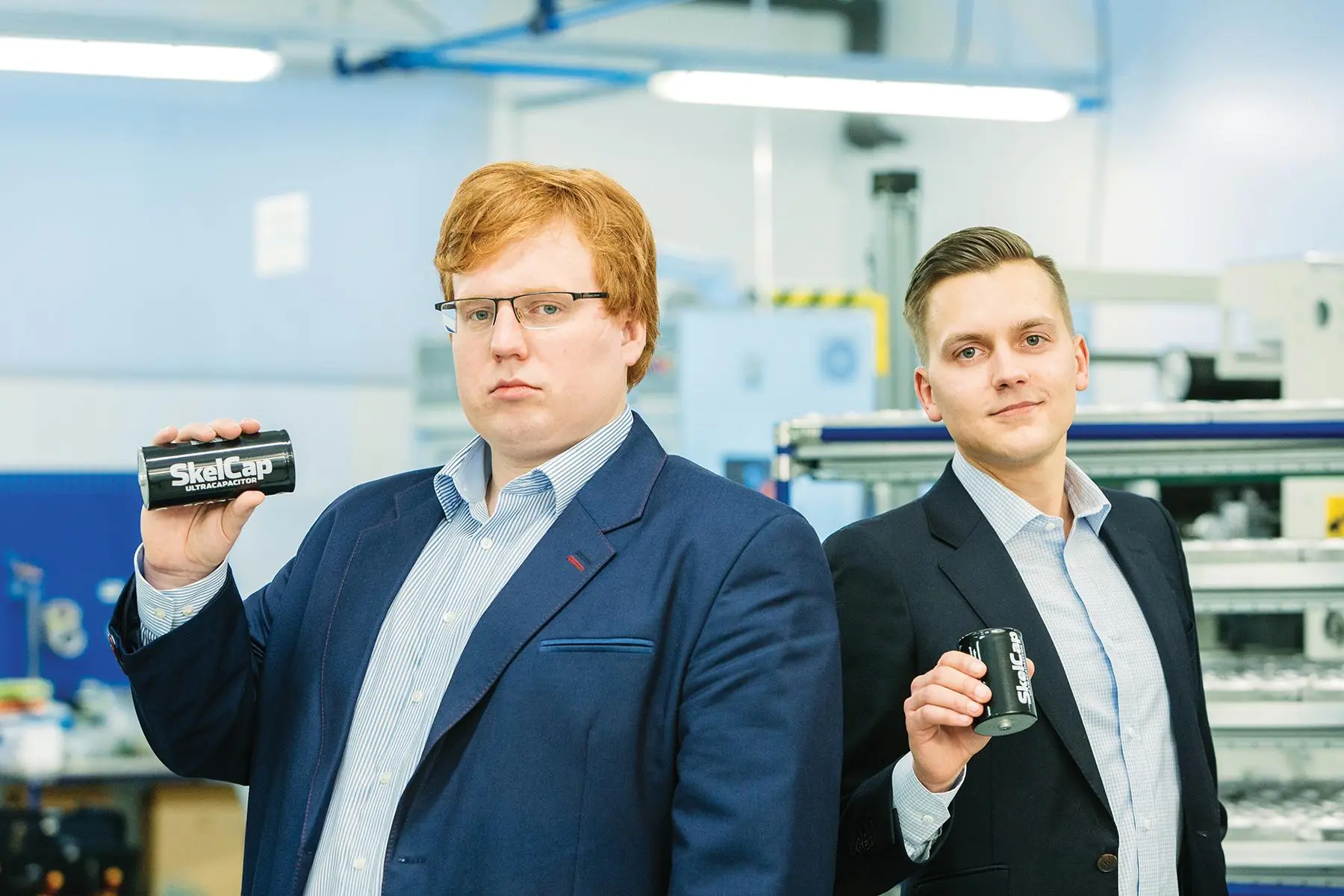
Taavi Madiberk: CEO and Co-Founder
Taavi Madiberk, CEO and co-founder of Skeleton Technologies, brings a unique blend of entrepreneurial drive and technical understanding to the company’s leadership.

Notably, he served as the youngest-ever Chairman of the Supervisory Board of Estonian Railways (AS Eesti Raudtee) from 2012 to 2014, a position that provided crucial insights into large-scale infrastructure and transportation challenges. He also served as a Member of the Supervisory Board of RKAS, an Estonian state-owned real estate company.
Oliver Ahlberg: Co-Founder and Chairman
Oliver Ahlberg is Skeleton Technologies’ co-founder and Chairman of the Board. He has been involved in the company’s operational development, IT capabilities and production systems.
The Scientific Foundation
Dr Jaan Leis and Dr Anti Perkson developed the materials research that underpins Skeleton’s Curved Graphene technology. Both were among the company’s co-founders, and their work later received recognition through the European Inventor Award in 2022.
Skeleton Technologies in 2026: From Energy Storage to AI Power Infrastructure
Skeleton Technologies’ strategy has expanded significantly beyond conventional supercapacitor applications. In 2026, the company increasingly positions itself as a power infrastructure provider for AI data centres and electricity grids, with its Curved Graphene technology forming the underlying materials platform.
The shift reflects a broader problem created by the rapid growth of AI computing. Modern data centres can experience highly dynamic electricity demand as GPUs move between different levels of computational activity. Skeleton’s systems are designed to respond to these rapid changes locally, reducing the burden placed on the wider electricity grid.
In May 2026, Skeleton announced the first close of a €33 million pre-IPO funding round. The company said the investment increased its total venture capital funding to €392 million and would support the scaling of its high-power energy storage technologies. New investors included Axon Partners Group, SmartCap and Taiwania Capital. Skeleton also stated that it was preparing for a planned US initial public offering in 2027.
The company has also expanded its product portfolio for AI infrastructure. In June 2026, Skeleton launched GrapheneUPS, a high-density uninterruptible power supply designed for AI data centres. The system is intended to provide continuous power protection while helping data centres manage grid disturbances and rapidly changing loads. Skeleton says GrapheneUPS can support up to 40% more computing power and a grid connection that is up to 44% smaller, although these figures are company-reported performance claims rather than independent industry benchmarks.
Skeleton has also continued expanding its partnerships around AI infrastructure. In July 2026, the company announced a collaboration with DG Matrix to integrate its high-power energy storage systems with solid-state transformer technology for 800 VDC AI data centres. The partnership targets power architectures designed for next-generation high-density computing facilities.
These developments mark an important change in Skeleton’s positioning. The company is no longer focused only on supplying high-performance supercapacitor cells. It is increasingly developing integrated power systems that sit between the electricity grid and energy-intensive computing infrastructure.
Revolutionary Technology: Understanding Curved Graphene
Curved Graphene is Skeleton Technologies’ proprietary carbon material and a core component of its high-power energy storage technology. Unlike conventional flat graphene, Skeleton’s material has a three-dimensional structure designed to provide a high accessible surface area and support low electrical resistance in supercapacitor electrodes.
What Makes Curved Graphene Different
How Curved Graphene Works in Skeleton Technologies’ Energy Storage
Skeleton Technologies describes Curved Graphene as a proprietary three-dimensional carbon material designed to improve the performance of high-power energy storage devices. The material is produced from silicon carbide and is used as the basis for Skeleton’s supercapacitor technology.
The important distinction is between energy and power. Conventional lithium-ion batteries are generally designed to store comparatively large amounts of energy for longer periods, while supercapacitors are particularly useful when an application needs to deliver or absorb large amounts of power very quickly.
Skeleton’s Curved Graphene approach is designed around this high-power requirement. Its three-dimensional structure provides a large accessible surface area for charge storage while supporting low electrical resistance. This allows Skeleton’s supercapacitors to respond rapidly to changes in power demand.
The technology therefore does not simply attempt to replace lithium-ion batteries. In many applications, Skeleton’s systems are designed to complement batteries by handling short-duration power peaks, rapid cycling and high-frequency fluctuations.
This distinction is important when assessing Skeleton Technologies. Its core proposition is not simply “graphene batteries”, but high-power energy storage and power-management systems built around a proprietary carbon material.
Performance Advantages of Curved Graphene Technology
Skeleton reported a 72% increase in energy density for its SCX5000 supercapacitor cell compared with its previous SCA3200 cell in the same form factor. The company reported ESR values as low as 0.2 to 1.6 mΩ for selected single-cell configurations.
Comprehensive Product Portfolio
Skeleton’s portfolio spans supercapacitor cells and modules, SuperBattery technology, and integrated power systems for applications ranging from transport and industry to AI data centres and electricity grids.
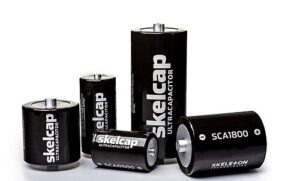
SkelCap Supercapacitor Series
The SkelCap supercapacitor line represents Skeleton’s core product offering, available in industry-standard D60 and D33 form factors. These cells deliver exceptional power density with extremely low internal resistance, long operational lifetimes exceeding 1 million charge-discharge cycles, and reliable performance across temperatures ranging from -40°C to 65°C. The D60 format has become the most popular cell size in the supercapacitor industry, while the D33 format serves specialised applications in automotive and data center environments where space constraints demand smaller components.
SkelCap is Skeleton’s supercapacitor product range, available in different cell formats for automotive, transport, grid, industrial and other high-power applications. The technology is designed for rapid charge and discharge, high power density and long cycle life. Skeleton also manufactures modules and systems built around these cells.
SuperBattery Technology
Skeleton’s SuperBattery combines characteristics of supercapacitors and batteries, targeting applications that require high power, rapid charging and greater energy capacity than conventional supercapacitors. This innovative solution combines the high-power capabilities and safety characteristics of supercapacitors with significantly increased energy capacity, making it ideal for applications requiring both substantial energy storage and rapid power delivery within 15 to 30-minute duty cycles.
SuperBattery technology offers several compelling advantages over conventional batteries. Skeleton states that its SuperBattery can charge in less than 90 seconds and offers up to 50,000 charge-discharge cycles. Skeleton says SuperBattery is designed without lithiated graphite and has undergone short-circuit, overcharging, crushing, nail penetration and overheating tests. The company states that the technology does not experience thermal runaway.
Skeleton says SuperBattery uses no cobalt, nickel, graphite or copper, reducing its reliance on several materials commonly associated with conventional lithium-ion batteries.
Skeleton Supercapacitors vs SuperBattery vs Lithium-Ion Batteries
Skeleton Technologies’ products should not be treated as a direct replacement for every type of lithium-ion battery. The technologies serve different energy-storage requirements.
| Technology | Main strength | Typical role | Charging and response |
|---|---|---|---|
| Skeleton supercapacitors | Very high power and rapid response | Power peaks, regenerative braking, grid stabilisation and short-duration backup | Extremely rapid charge and discharge |
| Skeleton SuperBattery | Combination of power, energy and fast charging | AI infrastructure, grid applications, mobility and industrial systems | Fast charging with high cycle capability |
| Lithium-ion battery | High energy storage capacity | Electric vehicles, stationary storage and longer-duration applications | Slower response and charging compared with supercapacitors |
| Hybrid systems | Combines different storage characteristics | Applications requiring both high power and longer energy duration | Optimised according to the application |
The practical advantage of Skeleton’s approach is therefore application-specific. Supercapacitors can handle rapid power fluctuations, while SuperBattery systems are intended to bridge some of the gap between high-power supercapacitors and conventional batteries.
For AI data centres, this distinction is particularly relevant because short-duration power fluctuations can occur much faster than the longer energy-storage requirements typically associated with conventional battery energy storage systems.
Modular Systems and Integrated Solutions
Beyond individual cells, Skeleton develops modules and integrated energy storage systems for transport, industrial, grid and AI applications. Its portfolio includes SkelMod modules, SkelGrid systems and AI infrastructure products such as GrapheneGPU and GrapheneBBU.
For larger-scale applications, Skeleton designs and manufactures complete energy storage systems. The SkelGrid systems deliver grid-scale energy storage capable of supplying tens of megawatts in seconds, making them suitable for utility-scale applications and large industrial installations. GrapheneGPU, the company’s latest innovation for AI data centers, comes as a complete rack-mountable solution that includes power electronics, software controls, and system integration, enabling data center operators to deploy the technology without extensive engineering work.
Skeleton Technologies: Key Applications
Skeleton Technologies serves diverse markets where high-power, reliable energy storage makes critical differences in performance, efficiency, and economics. The company’s solutions address fundamental challenges across multiple sectors.
AI Data Centers: Powering the Computing Revolution
The growth of AI workloads is creating new power-management challenges for data centres. Unlike traditional computing workloads that maintain relatively steady power consumption, AI operations, particularly during model training and inference, create dramatic power fluctuations. AI workloads can create rapid changes in data centre power demand, creating challenges for grid connections, power quality and local infrastructure.
These rapid power fluctuations create enormous challenges. Grid infrastructure must be oversised to handle peak loads, resulting in substantial capital expenditure for connections that remain underutilised most of the time. To maintain grid stability, data centers often run artificial calculations on GPUs, creating “dummy loads” that smooth power demand but waste enormous amounts of energy.
Skeleton Technologies and AI Data Centre Power
AI data centres have become one of Skeleton Technologies’ most important growth markets because modern GPU infrastructure creates demanding power profiles. Skeleton’s systems are designed to manage these fluctuations close to the computing equipment rather than relying solely on wider grid infrastructure.
GrapheneGPU was introduced in 2025 as a power-management system for AI data centres. Skeleton says the system can reduce energy consumption by up to 45%, reduce power connection requirements by up to 44% and increase computing performance by up to 40% under the company’s tested operating conditions. These figures are Skeleton’s reported results and should not be interpreted as universal performance levels across all data centres.
In 2026, Skeleton expanded this product strategy with GrapheneUPS, a high-density UPS designed specifically for AI infrastructure. The company says GrapheneUPS can provide continuous power protection, mitigate short-duration grid disturbances and support rapidly changing AI workloads. It can be deployed in different configurations, including close to critical IT equipment.
Skeleton has also moved towards higher-voltage data centre architectures. In July 2026, it announced a collaboration with DG Matrix covering 800 VDC AI data centres. The companies are integrating Skeleton’s fast-response energy storage with DG Matrix’s solid-state transformer platform, targeting power architectures for high-density AI computing.
This development highlights an important trend in AI infrastructure: the energy problem is not limited to the amount of electricity consumed by GPUs. Data centre operators also need to manage power quality, peak demand, grid connection capacity, resilience and rapid load changes.
Skeleton Technologies developed GrapheneGPU specifically to address these challenges. This innovative solution uses curved graphene-based supercapacitors to absorb power spikes during intensive computing and releases stored energy during low-demand periods, maintaining smooth power delivery to the grid. The system operates at microsecond speeds, fast enough to buffer the rapid fluctuations characteristic of AI workloads.
GrapheneGPU can reduce total electricity consumption by up to 44% by eliminating wasted energy from dummy loads and reducing cooling requirements. Grid connection requirements can be reduced by similar margins, either lowering initial infrastructure costs for new facilities or enabling greater compute density in existing buildings with limited power capacity.
Major technology companies have recognised the value of this approach. Skeleton Technologies works with leading US cloud operators and AI infrastructure companies, deploying GrapheneGPU solutions in hyperscale data centers. The company’s partnership with Acbel resulted in GrapheneBBU, a battery backup unit combining SuperBattery technology with sophisticated power management, providing both peak shaving and uninterruptible power supply functionality in a single integrated system.
Grid Stability and Energy Infrastructure
Skeleton Technologies provides critical infrastructure for grid operators facing these challenges. The company’s supercapacitor systems deliver instantaneous power injection or absorption, responding to frequency deviations and voltage fluctuations within milliseconds. This ultra-fast response time proves essential for modern grids, where renewable energy can create rapid changes that traditional spinning reserve generators cannot address quickly enough.
Skeleton’s solutions excel in grid applications due to their exceptional reliability and longevity. With operational lifetimes exceeding 15 years and over 1 million charge-discharge cycles, supercapacitor systems require minimal maintenance while delivering consistent performance. The technology operates efficiently across extreme temperature ranges, from Arctic conditions to desert heat, ensuring reliable operation regardless of climate or location.
Current customers include industry leaders such as Hitachi Energy, Siemens, and General Electric, who integrate Skeleton’s technology into grid stabilisation systems, substations, and renewable energy installations. The company supplies systems ranging from small installations for local grid support to massive 100 MW+ power banks for utility-scale applications.
Transportation and Automotive Applications
Skeleton has a long history in transportation applications, where supercapacitors can capture regenerative braking energy and deliver rapid power. Its technology has been used in trams, buses, trucks and other transport systems, including rail projects involving Škoda and Medcom. The company also supplies supercapacitor technology for automotive and heavy-duty applications.
Strategic Manufacturing and European Value Chain
Skeleton Technologies has invested heavily in manufacturing infrastructure across Europe, establishing a vertically integrated production ecosystem that spans from raw materials to complete systems. This European focus ensures supply chain security, reduces dependence on imported critical materials, and strengthens the continent’s strategic autonomy in energy storage technologies.
Leipzig SuperFactory: Large-Scale Supercapacitor Production
Skeleton officially opened its €220 million Leipzig SuperFactory in Markranstädt, Germany, in November 2025. The facility is designed to produce up to 12 million supercapacitor cells annually and supplies applications including European electricity grids and AI infrastructure.
The factory manufactures Skeleton’s latest graphene-based supercapacitors and supplies products for both European electricity-grid applications and AI infrastructure. Skeleton has said the facility is already supplying companies including Siemens, GE and Hitachi Energy for grid applications, alongside major US hyperscalers for AI infrastructure.
The facility is strategically important because it gives Skeleton large-scale manufacturing capacity within Europe while supporting its vertically integrated approach to materials, cells, modules and power systems.
Finnish SuperBattery Production
Skeleton officially opened its €50 million SuperBattery factory in Varkaus, Finland, in November 2025. The facility produces SuperBattery cells for AI data centres, grid stability, mobility and other high-power applications. Skeleton is now scaling the site towards 10 million cells annually by Q3 2029, equivalent to around 580 MWh of annual cell production.
The Varkaus factory incorporates niobium-based electrode materials supplied by CBMM, a Brazilian niobium producer. These advanced materials enhance battery safety, performance, and lifetime, enabling faster charging, longer durability, and greater reliability for demanding AI and industrial applications. The partnership with CBMM demonstrates Skeleton’s commitment to using the most advanced materials available to optimize performance.
Varkaus SuperBattery Expansion
Skeleton is also scaling its SuperBattery manufacturing operation in Varkaus, Finland. In May 2026, the company announced the SB-VARKAUS project, which aims to increase the facility from pilot production to an industrial capacity of 10 million cells annually by the third quarter of 2029.
At full operation, the planned production capacity is expected to reach approximately 580 MWh of cells per year at the Varkaus site. Skeleton says the project is focused on high-power energy storage for applications including grid frequency regulation, while also supporting the wider commercialisation of its SuperBattery technology.
The expansion is significant because it moves Skeleton’s SuperBattery strategy from pilot-scale manufacturing towards industrial production. It also strengthens Finland’s role in Skeleton’s European manufacturing network alongside its supercapacitor operations in Germany.
Skeleton Technologies Funding and Financial Development
Skeleton Technologies has built one of Europe’s better-funded deep-tech energy storage businesses, with capital raised from venture investors, strategic industrial partners and European public institutions.
The company’s funding history is particularly relevant because its business requires significant capital expenditure to move from laboratory-scale materials research to commercial manufacturing.
Skeleton Technologies Funding Timeline
| Period | Funding or investment | Significance |
|---|---|---|
| 2017 | €15 million EIB financing | Supported manufacturing expansion and R&D |
| 2021 | Major Series D investment | Supported European manufacturing scale-up |
| 2022 | Further Series D financing | Continued production and technology expansion |
| 2023 | Major strategic investment rounds | Added Siemens Financial Services, Marubeni and CBMM |
| 2025 | Major manufacturing investment | Supported the Leipzig SuperFactory and European production expansion |
| May 2026 | €33 million first close of pre-IPO round | Took total venture capital funding to €392 million |
The exact structure of Skeleton’s historical financing has changed across equity, strategic investment and public financing rounds, so funding databases can report different totals depending on whether they include debt, quasi-equity and other forms of capital.
What is the latest Skeleton Technologies funding?
Skeleton Technologies’ latest announced financing is the first close of a €33 million pre-IPO funding round announced in May 2026. The company said the round increased its total venture capital funding to €392 million.
Axon Partners Group, SmartCap and Taiwania Capital joined the investor base in the new round. Skeleton said the financing would support the expansion of its high-power energy storage systems for AI data centres and electricity grids as it prepares for a planned US IPO in 2027.
The company was also selected in 2026 to advance through the EIC STEP Scale Up process, where it could potentially receive between €10 million and €30 million in equity investment, subject to further due diligence and an investment decision.
€33 Million Pre-IPO Funding Round
The most important recent financing event came in May 2026, when Skeleton announced the first close of a larger pre-IPO funding round at €33 million. The company said the financing brought its total venture capital funding to €392 million. New investors included Axon Partners Group, SmartCap and Taiwania Capital.
Skeleton said the funding would support the continued scaling of its high-power energy storage systems for AI infrastructure and electricity grids. The company is also preparing for a planned US IPO in 2027, although the timing and completion of any future listing remain subject to market conditions and the company’s preparations.
European Public Funding
Skeleton’s development has also received European public-sector support. In 2017, the European Investment Bank signed a €15 million quasi-equity financing agreement with Skeleton to support research, development and manufacturing expansion in Estonia and Germany.
The company has subsequently received additional European and Finnish public support for its manufacturing and technology development activities. In 2025, Skeleton’s Varkaus SuperBattery project received nearly €7 million through Finland’s ELY Centre, funded by the EU Just Transition Fund.
In 2026, Skeleton was also selected as one of six European companies to advance through the evaluation stage of the European Innovation Council’s STEP Scale Up call. The company was put forward for a potential EIC Fund equity investment of between €10 million and €30 million, subject to due diligence and an investment decision. This should not be described as funding already received.
Skeleton Technologies IPO: What We Know
Skeleton Technologies has indicated that it is preparing for a planned US initial public offering in 2027. The company referenced the planned listing when announcing its €33 million pre-IPO funding round in May 2026.
The proposed IPO has not yet taken place, so there is no public-market share price or completed listing to analyse. The timing, exchange, valuation and final structure of any IPO may change as Skeleton progresses through the preparation process.
The pre-IPO financing gives the company additional capital to expand its manufacturing footprint and develop power systems for AI infrastructure and electricity grids. It also adds investors with experience across technology, growth capital and strategic infrastructure markets.
Innovation and Intellectual Property
Skeleton Technologies says it holds more than 70 patent families covering areas including Curved Graphene production, energy storage cells, modules, power electronics and integrated systems. The company describes this intellectual property as covering its vertically integrated technology and production platform.
Global Customer Base and Strategic Partnerships
Skeleton’s customers and partners span energy, transport, automotive, industrial and AI infrastructure markets. Its current materials identify companies including Siemens, GE, Hitachi Energy, BMW, Honda, Volvo and Škoda among organisations using or working with Skeleton technology. The company has also partnered with Acbel on GrapheneBBU for AI data centre backup power.
What Does Skeleton Technologies Make?
Skeleton Technologies develops energy storage cells, modules and integrated power systems designed for applications where rapid power delivery, power quality and frequent cycling are important.
Its portfolio can broadly be divided into four areas.
Supercapacitors: High-power storage devices designed for rapid charge and discharge, including grid, transport and industrial applications.
SuperBattery: A hybrid energy storage technology intended to combine characteristics of supercapacitors and batteries, with applications in AI infrastructure, grids, mobility and industry.
AI data centre power systems: Products such as GrapheneGPU and GrapheneUPS are designed to manage rapidly changing loads, provide power protection and reduce infrastructure constraints associated with high-density computing.
Grid and industrial systems: Skeleton develops systems for applications including frequency regulation, grid stabilisation, backup power and industrial power management.
The company’s strategy is therefore broader than manufacturing individual energy storage cells. Skeleton is increasingly developing complete power systems that connect energy storage technology with power electronics, controls and the infrastructure surrounding high-power applications.
Competitive Landscape and Market Position
Skeleton Technologies competes in the global energy storage market against various players, though few directly compete across all the company’s application areas. Traditional supercapacitor manufacturers like Maxwell Technologies (acquired by Tesla in 2019) and Eaton produce competing products, though independent testing suggests Skeleton maintains substantial performance advantages.
In the emerging SuperBattery market, Skeleton faces different competition from established battery manufacturers and startups developing advanced battery chemistries. However, Skeleton’s unique positioning in the high-power, fast-charging segment creates a distinct market niche where few competitors can match performance specifications.
The company’s key competitive advantages include its proprietary Curved Graphene material, extensive patent protection, vertically integrated European manufacturing, proven track record with tier-one customers, and comprehensive product portfolio spanning cells to complete systems. These factors combine to create a sustainable competitive position that will be difficult for competitors to replicate.
Why Skeleton Technologies Matters to Europe’s Deep-Tech Ecosystem
Skeleton Technologies is an example of the type of capital-intensive deep-tech company Europe is trying to scale from scientific research into industrial production.
The company’s technology sits at the intersection of several European strategic priorities: energy storage, electricity-grid modernisation, AI infrastructure, advanced materials and domestic manufacturing.
Its manufacturing footprint is also significant. Curved Graphene production is located in Germany, large-scale supercapacitor manufacturing is centred on the Leipzig facility, SuperBattery production is being expanded in Finland, and the company retains its headquarters and engineering activities in Estonia.
The company therefore illustrates a different path from software-led European startups. Scaling advanced materials and energy hardware requires factories, equipment, supply chains, industrial partnerships and substantial long-term capital.
That is reflected in Skeleton’s funding history. The company has attracted private investment alongside support from institutions such as the European Investment Bank and European innovation programmes. In 2026, it also advanced through the EIC STEP Scale Up evaluation process for a potential additional equity investment.
For Europe’s deep-tech ecosystem, Skeleton’s development is therefore relevant not only because of its Curved Graphene technology, but because it demonstrates the challenge of turning European materials science and engineering into globally competitive industrial infrastructure.

What is Skeleton Technologies' Curved Graphene?
Curved Graphene is Skeleton Technologies' proprietary carbon material used in its supercapacitor and energy storage technologies. The company says the three-dimensional structure is designed to provide high power density and rapid charge and discharge performance.
How much has Skeleton Technologies raised?
Skeleton announced a €33 million first close of a pre-IPO funding round in May 2026, taking its total venture capital funding to €392 million.
Who founded Skeleton Technologies?
Skeleton Technologies was founded in Estonia in 2009. Taavi Madiberk is the company's CEO and co-founder, while Oliver Ahlberg is co-founder and Chairman of the Board. The company also identifies Dr Linus Froböse as its Chief Technology Officer.
Where is Skeleton Technologies based?
Skeleton Technologies is headquartered in Tallinn, Estonia. It operates manufacturing and technology facilities in Germany and Finland, including Curved Graphene production in Bitterfeld-Wolfen, the Leipzig SuperFactory in Markranstädt and SuperBattery production in Varkaus.
What is Skeleton Technologies' SuperBattery?
SuperBattery is Skeleton's high-power energy storage technology designed to combine characteristics associated with supercapacitors and batteries. The technology is being developed for applications including AI infrastructure, electricity grids, mobility and industry.
What does Skeleton Technologies do for AI data centres?
Skeleton develops power systems designed to manage rapid changes in AI data centre electricity demand. GrapheneGPU is designed to smooth GPU power fluctuations, while GrapheneUPS provides power protection and grid-stabilisation capabilities for AI infrastructure.
Is Skeleton Technologies going public?
Skeleton Technologies has said it is preparing for a planned US initial public offering in 2027. The company has not completed that IPO, so the timing and final structure of any listing remain subject to future developments.
Where does Skeleton Technologies manufacture SuperBatteries?
Skeleton's SuperBattery production is based in Varkaus, Finland. The company is scaling the facility towards a planned capacity of 10 million cells annually by Q3 2029, equivalent to approximately 580 MWh of annual cell production at full operation.